

Understanding how discipline actually works in real market conditions
Published: March 2026
Last Updated: April 2026
INTRODUCTION
Over the last few years, participation in Indian financial markets has increased rapidly.
More people are trading.
More people are learning.
More people are trying to “figure it out.”
But there’s one thing most beginners don’t realize early:
Understanding the market is one thing.
Staying consistent in your behaviour is another.
Data from the National Stock Exchange of India shows a steady rise in retail participation, especially in segments like derivatives.
With this growth, one area has become more important than ever:
Behaviour.
Most discussions focus on:
- Strategies
- Indicators
- Setups
But very little attention is given to:
How you actually behave when the market is moving.
The Securities and Exchange Board of India, through its investor awareness initiatives, consistently highlights the importance of informed participation.
And informed participation is not just about knowledge.
It’s also about behaviour.
WHY THIS TOPIC MATTERS
Many beginners believe:
“If I learn the right strategy, I’ll be consistent.”
But in reality:
You can understand everything…
and still act inconsistently.
You might have experienced this:
- Knowing what to do, but not doing it
- Changing decisions midway
- Reacting to market moves instead of following your plan
This is where discipline comes in.
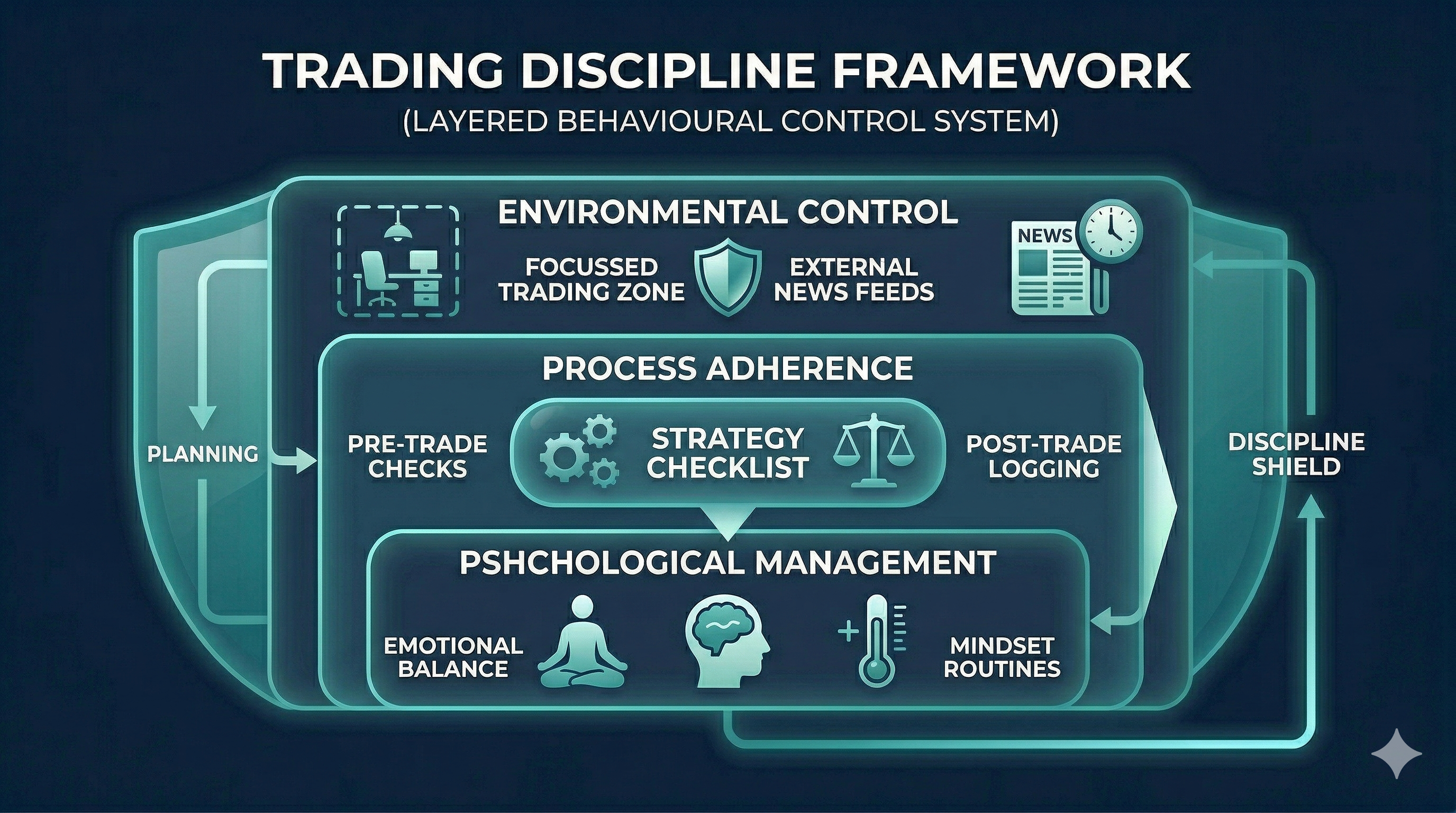
WHAT IS TRADING DISCIPLINE?
Trading discipline is your ability to:
Follow a defined decision-making process—
even when the market creates pressure.
It is not a tool.
It is not a strategy.
It is how you behave when things don’t go as expected.
WHAT IS BEHAVIOURAL CONSISTENCY?
Behavioural consistency means:
Applying the same logic again and again—
regardless of recent outcomes.
Not:
- Changing decisions after one loss
- Becoming aggressive after one win
But:
Staying stable in how you think and act.
HOW MARKETS INFLUENCE YOUR BEHAVIOUR
Markets are not just numbers on a screen.
They trigger reactions:
- Fear when price moves against you
- Excitement when things go your way
- Doubt when outcomes are uncertain
In Indian markets, especially in fast-moving segments like derivatives, this becomes even more visible.
The faster the market moves,
the faster behaviour changes.
EMOTIONAL INFLUENCE IN TRADING
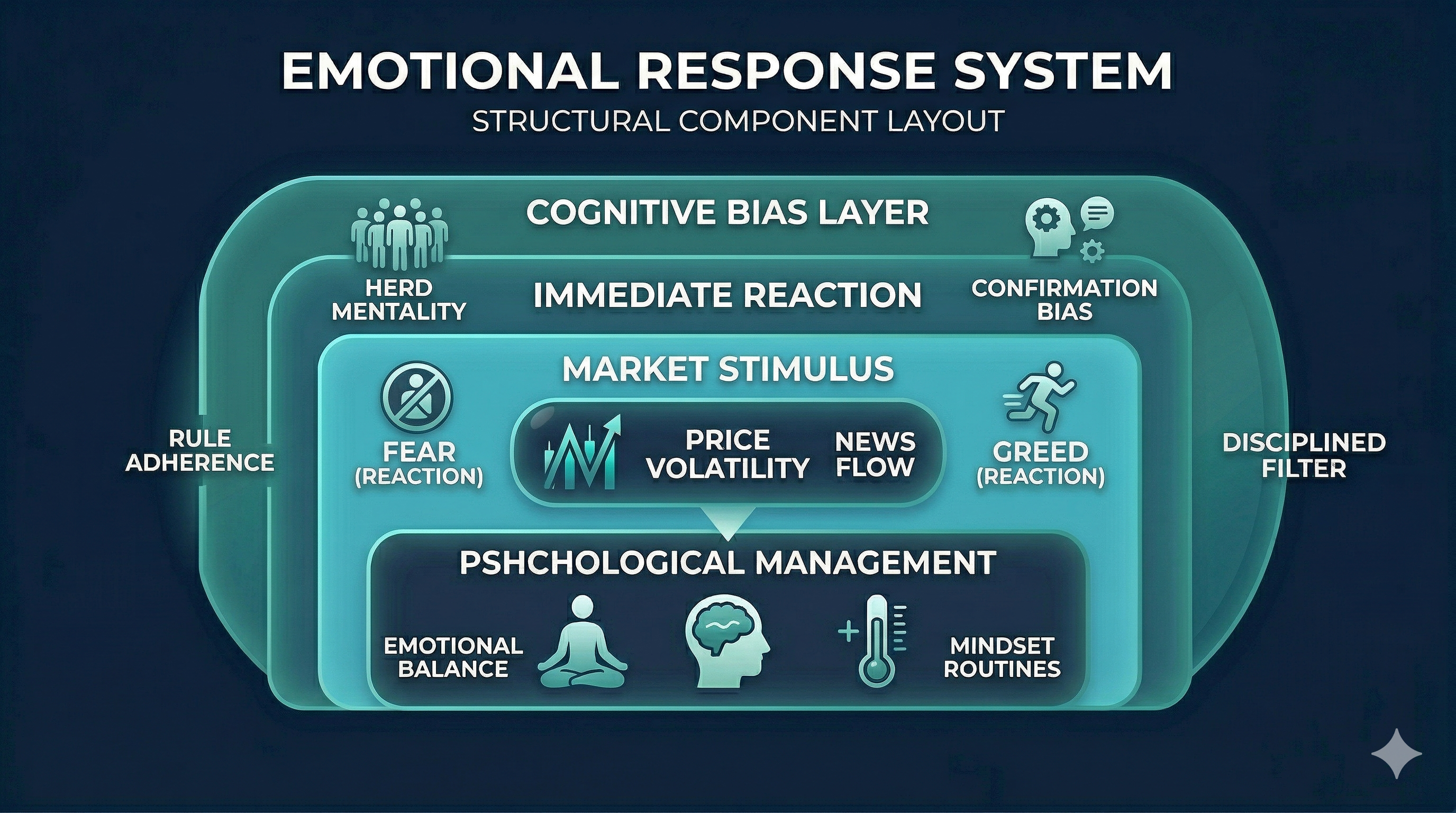
You don’t just observe price.
You react to it.
- You exit early because of fear
- You hold longer because of hope
- You enter late because of excitement
This is not strategy.
This is behaviour.
ROLE OF A DECISION-MAKING FRAMEWORK
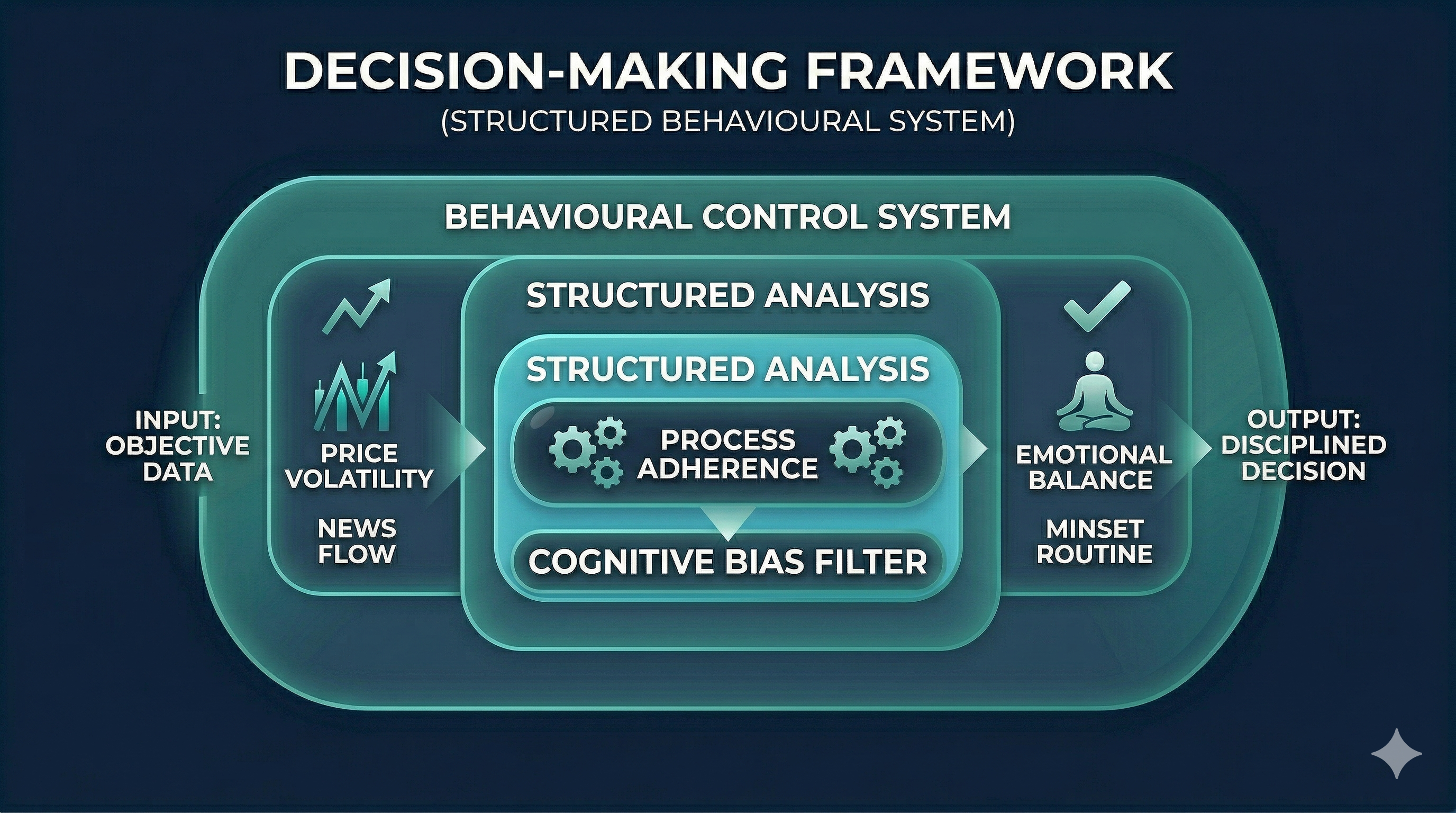
Discipline doesn’t come from willpower.
It comes from structure.
A decision-making framework defines:
- When you act
- Why you act
- How you respond
Without structure, behaviour becomes reactive.
CONSISTENCY VS REACTION
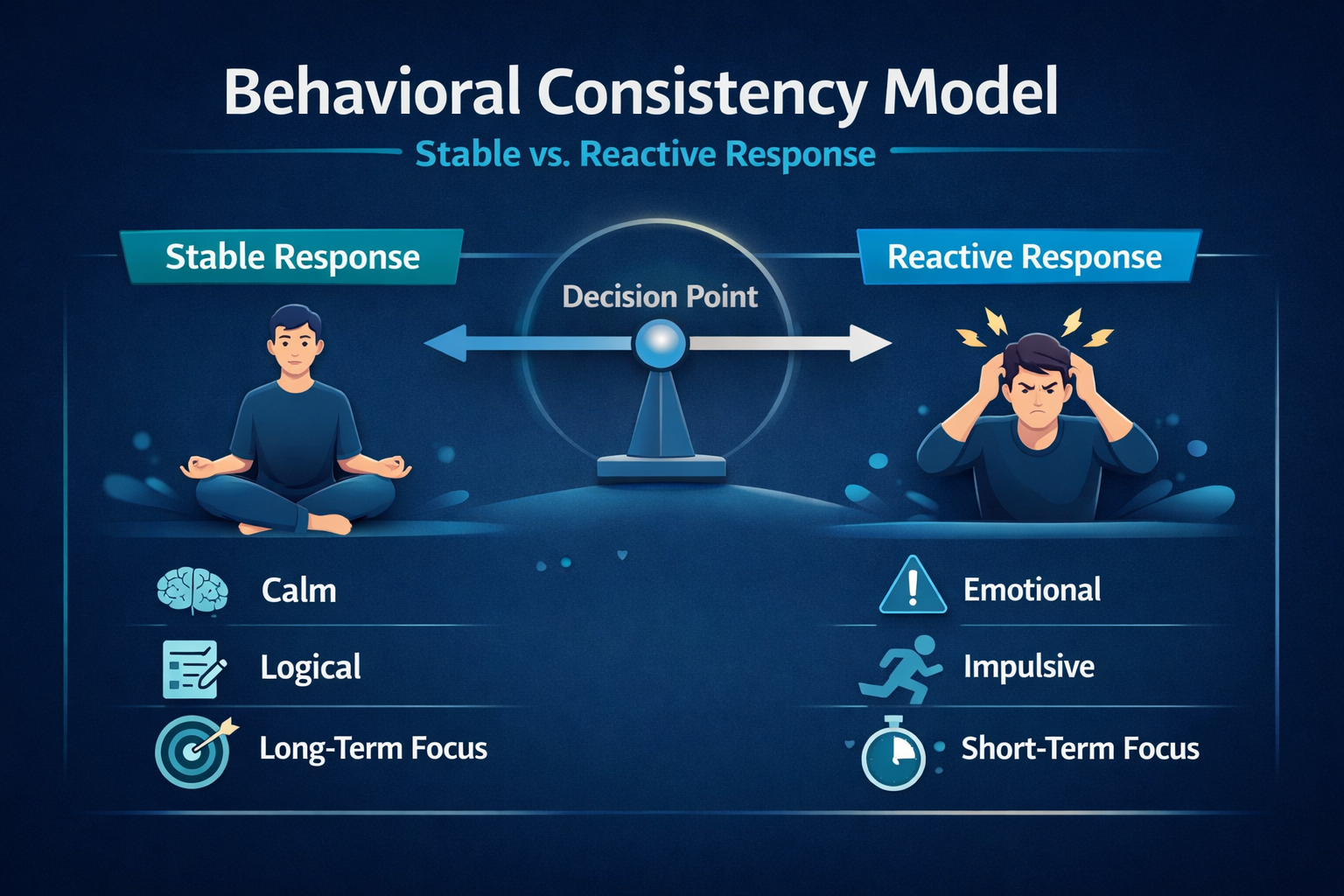
One of the biggest gaps in trading:
- Reaction = emotional
- Response = structured
Most beginners shift behaviour based on:
- Recent trades
- Market noise
- External opinions
Consistency means staying aligned with your process—
not your last result.
CONCEPTUAL COMPARISON
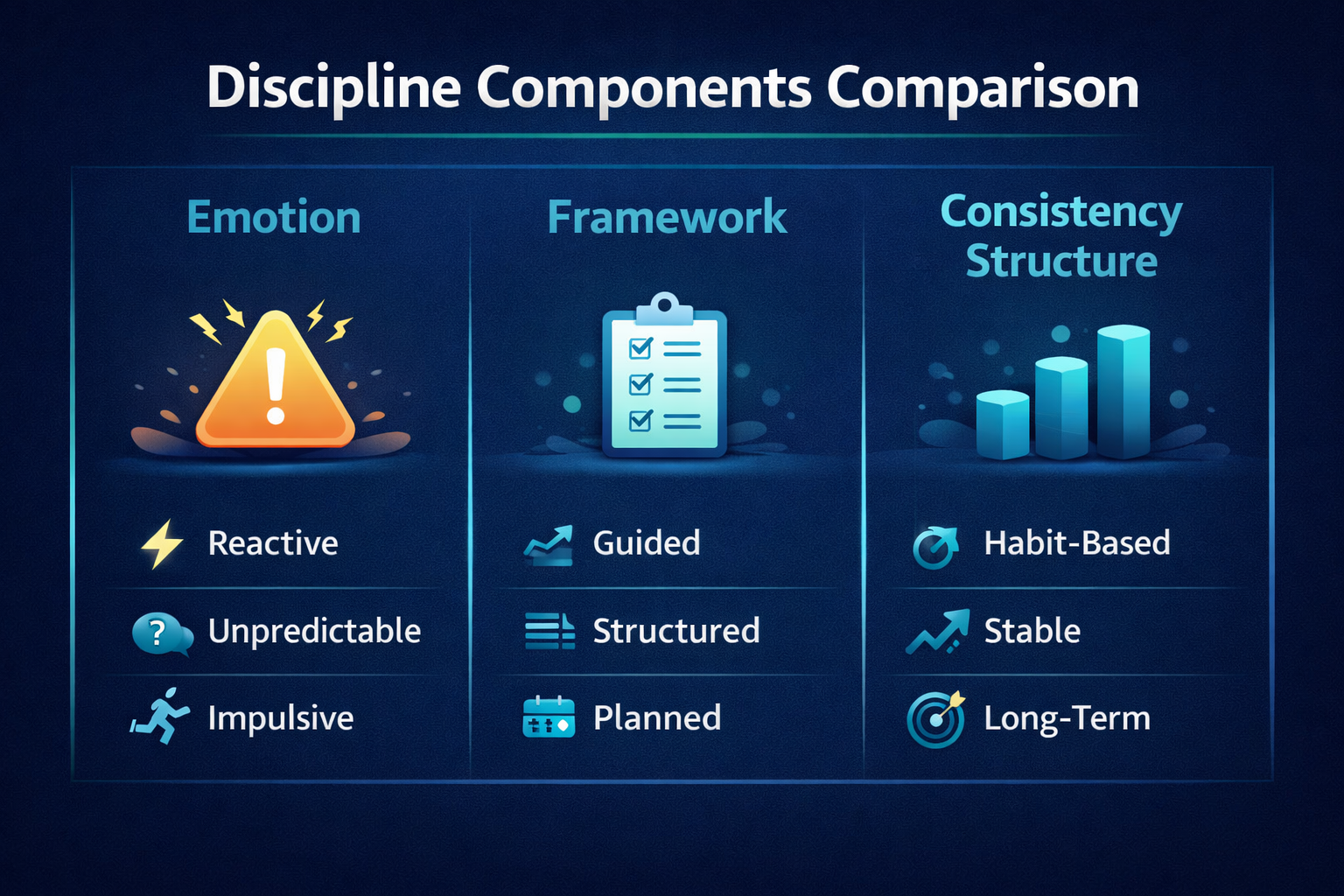
| Concept | Core Issue | Market Impact | Learning Challenge |
|---|---|---|---|
| Emotional Influence | Reactive behaviour | Inconsistent decisions | Managing response |
| Decision Framework | Need for structure | Improved clarity | Maintaining adherence |
| Behavioural Consistency | Stability vs variability | Predictable behaviour pattern | Avoiding deviation |
COMMON BEGINNER MISTAKES
- Focusing only on strategy, ignoring behaviour
- Reacting impulsively to price movement
- Changing decision logic frequently
- Following external opinions
- Ignoring emotional influence
These are not technical problems.
They are behavioural gaps.
LIMITATIONS
Understanding discipline conceptually is one thing.
Applying it consistently is different.
In real markets:
- Emotions are active
- Outcomes are uncertain
- Pressure is real
Discipline develops over time.
RISK AWARENESS
Investor education by the Securities and Exchange Board of India highlights that market participation involves behavioural risks.
Insights from the Reserve Bank of India show that macroeconomic conditions influence volatility.
And volatility influences behaviour.
WHAT THIS DOES NOT DO
Understanding discipline:
- Does not ensure consistency
- Does not eliminate emotional reactions
- Does not guarantee outcomes
BEGINNER LEARNING PATH
- Understand market behaviour
- Study decision-making basics
- Recognize emotional influence
- Learn behavioural consistency
- Develop awareness of limitations
FINAL PERSPECTIVE
Discipline is often misunderstood as control.
But in trading, it is something else.
It is the ability to stay consistent
when inconsistency feels easier.
Markets will move.
Your behaviour determines your response.
FAQ SECTION
What is trading discipline?
It is the ability to follow a consistent decision-making process in the market despite emotional or external pressure.
Why is discipline important in trading?
Because market conditions constantly change, and without discipline, behaviour becomes reactive and inconsistent.
Is discipline a trading strategy?
No. Discipline is not a strategy—it is a behavioural framework that supports how strategies are applied.
Why do beginners struggle with discipline?
Due to emotional reactions, lack of structured decision-making, and influence from recent outcomes or external opinions.
Can discipline be developed quickly?
No. Discipline typically develops over time through repeated exposure and structured practice in market conditions.
AUTHOR
Vicky Mehta
Stock Market Trainer & Mentor
Founder & CEO – Succinct Learning Platforms Pvt. Ltd.
With over 20+ years in financial markets, his work focuses on structured trading education, behavioural frameworks, and risk management. He holds an MBA in Financial Markets in collaboration with NSE Academy and is an NSE Certified Market Professional.
CONTINUE LEARNING
If you’re trying to understand markets in a more structured way,
I share short, focused breakdowns regularly here:
👉 [https://whatsapp.com/channel/0029VbBvyJ2EAKWHIrvdm436]
DISCLAIMER
This content is for educational purposes only and does not constitute financial advice.
Financial markets involve risk, including potential loss of capital. Readers should consult a SEBI-registered investment advisor before making financial decisions.
other related topic
Most Traders Think Backtesting Proves a Strategy. It Doesn’t.