

Published: May 2026
Last Updated: April 2026
INTRODUCTION
Over the last few years, India has seen a massive rise in retail participation in the stock market. More people are opening trading accounts, watching market-related content, and exploring instruments listed on the National Stock Exchange of India and Bombay Stock Exchange.
For many beginners, the journey starts with curiosity. Someone sees market discussions on YouTube. Someone hears friends talking about options trading. Others enter after seeing social media screenshots, fast-moving charts, or news about market rallies.
But after the initial excitement fades, many beginners start facing a common problem. Their behaviour becomes inconsistent.
Some days they feel confident. On other days, completely confused. One week they follow one approach. The next week they shift to another. Slowly, frustration replaces clarity.
This is not always because a person lacks effort. In many cases, the real issue is misunderstanding how financial markets actually function.
The Securities and Exchange Board of India regularly highlights the importance of investor awareness and risk understanding. Yet a large amount of market-related content available online focuses more on outcomes and speed than on structure and behaviour.
This article is written purely for educational purposes. Its objective is to explain why consistency becomes difficult for many beginners, especially in a fast-moving retail environment like India.
WHY THIS TOPIC MATTERS FOR LEARNERS
A large number of beginners believe consistency comes only from finding the “right strategy” or the “right setup.” That belief creates a cycle of constant searching.
When expectations are built around certainty, confusion starts growing very quickly.
Many new market participants are not struggling because they are incapable of learning. They struggle because markets are dynamic systems. Conditions change. Behaviour changes. Participation changes.
In India, retail participation has increased sharply in recent years. Along with this growth, exposure to derivatives has also increased. Beginners are now interacting with fast-moving instruments before fully understanding concepts like volatility, liquidity, and behavioural pressure.
This matters because inconsistency is not only a technical issue. It is also psychological and structural.
A common real-world observation is this: many beginners spend more time consuming market content than understanding market behaviour. They keep collecting information, but their decision-making becomes more unstable over time.
That gap between information and understanding is where confusion usually begins.
DEFINITION
1. What Is Consistency in Trading?
Consistency in trading refers to maintaining stable behaviour, structured thinking, and disciplined participation despite changing market conditions. It does not mean markets will behave predictably.
In educational terms, consistency is more connected to behavioural stability than market outcomes.
2. What Is Behavioural Instability?
Behavioural instability refers to irregular decision-making caused by emotional reactions, information overload, uncertainty, or changing expectations.
In financial markets, this may appear through impulsive participation, frequent strategy changes, or excessive reaction to short-term market movement.
EXPLANATION
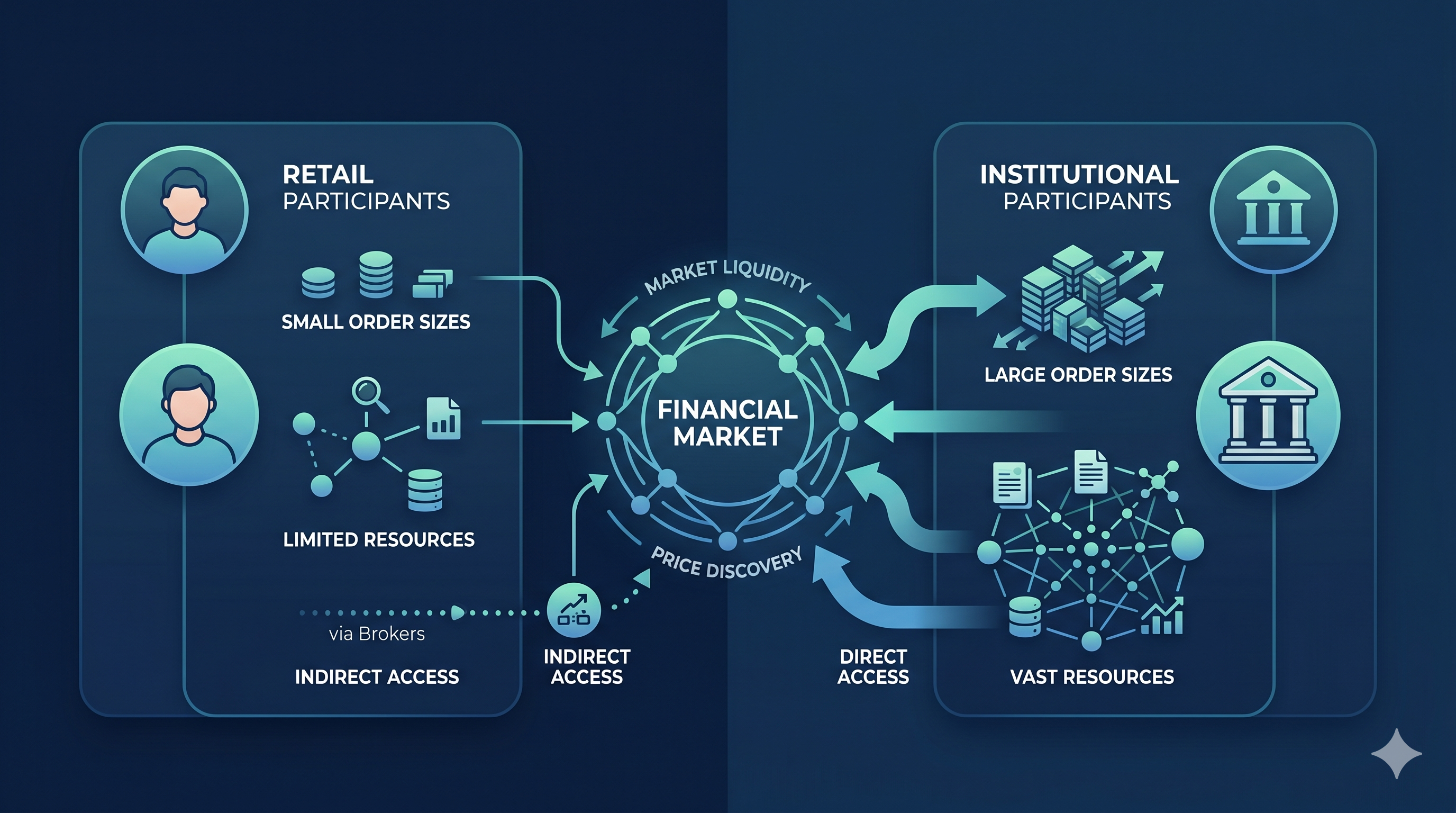
Financial markets are influenced by multiple participants at the same time. Institutions, retail traders, mutual funds, foreign investors, algorithms, and hedging participants all interact within the same system.
Because of this, market movement is never driven by a single reason.
Beginners often enter the market expecting clean patterns and fixed behaviour. But real markets are noisy. Sometimes prices move with logic. Sometimes they react sharply to news, liquidity shifts, or global sentiment.
This creates mental pressure for inexperienced participants.
A beginner may spend weeks studying one concept, only to see the market behave differently than expected. That experience can create self-doubt, confusion, and constant switching between methods.
Behavioural finance research has repeatedly shown that uncertainty affects human decision-making. Financial markets amplify this effect because feedback is immediate, emotional, and often unpredictable.
The challenge, therefore, is not just learning market concepts. The challenge is understanding that markets do not provide certainty in the way many beginners expect.
INFORMATION OVERLOAD AND MARKET CONFUSION

Structural Characteristics
Today’s beginners are exposed to nonstop market information.
Charts, indicators, opinions, live sessions, economic news, options discussions, and social media clips appear continuously throughout the day. On the surface, this looks educational. But excessive information often creates mental clutter instead of clarity.
A person may learn one concept in the morning and completely contradict it by evening after watching another video.
This creates fragmented understanding.
The problem becomes bigger when content is consumed without context. Terms like “support,” “resistance,” “breakout,” or “option chain” are discussed frequently online, but beginners may not fully understand how these concepts fit into broader market structure.
Market Context (India-specific)
India’s digital trading ecosystem has expanded rapidly. Low brokerage costs, smartphone accessibility, and simplified trading apps have made participation easier than ever.
At the same time, derivatives activity among retail participants on the National Stock Exchange of India has increased significantly.
Many beginners now enter highly volatile market segments very early in their learning journey.
This creates a situation where accessibility grows faster than conceptual understanding.
The result is often confusion rather than clarity.
Behavioural Considerations
Too much information can reduce independent thinking.
Beginners start comparing every opinion. One expert says bullish. Another says bearish. One strategy focuses on indicators. Another focuses on price action.
Slowly, confidence gets replaced by dependency.
Some participants begin checking charts repeatedly throughout the day. Others keep changing their market views after every small movement.
Behaviour becomes reactive. Stability disappears.
MISUNDERSTANDING MARKET UNCERTAINTY
Structural Characteristics
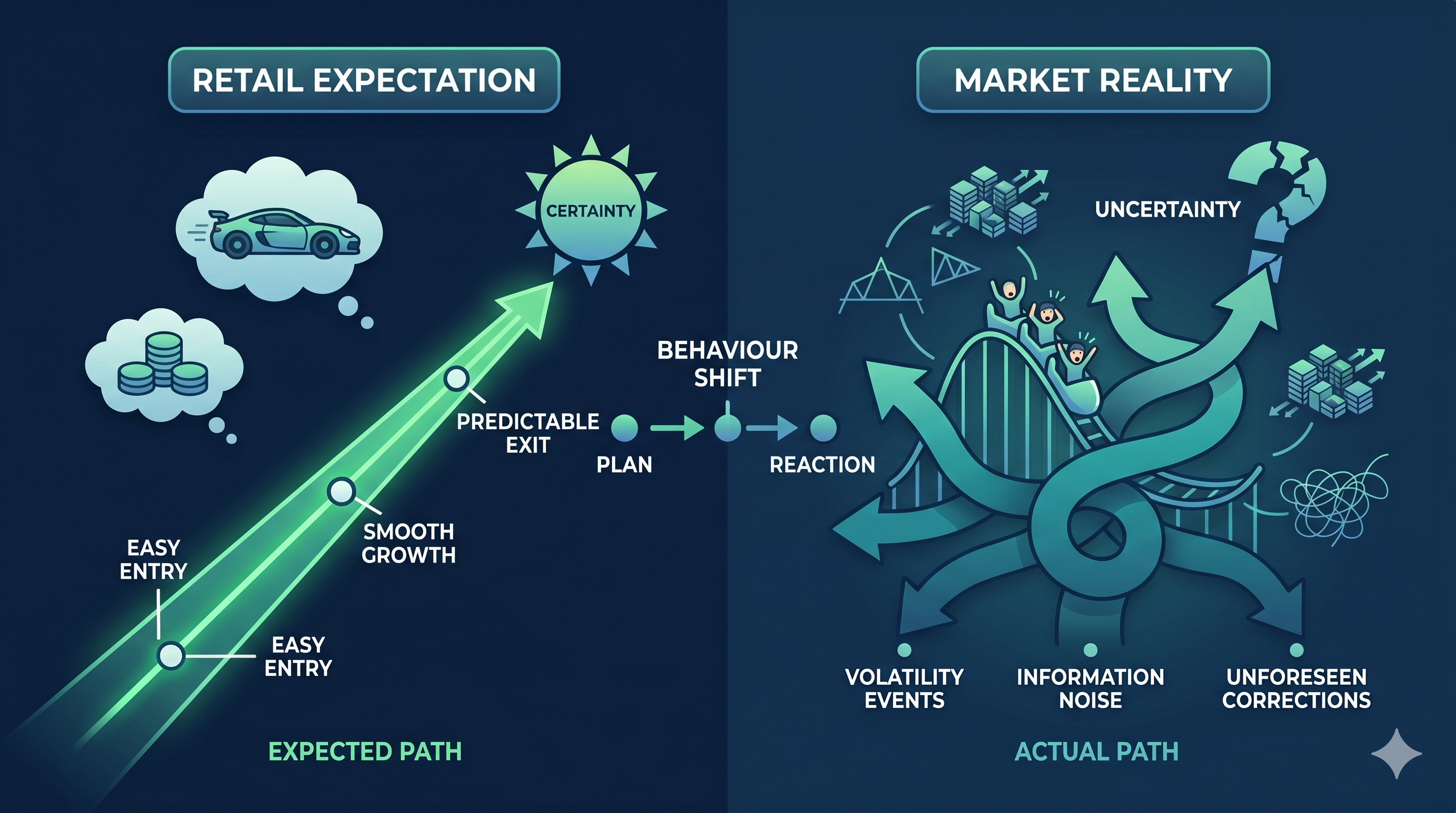
Many beginners believe that if they study enough, markets will eventually become predictable.
That assumption creates unrealistic expectations.
Financial markets are probability-driven systems influenced by economic data, liquidity, global events, institutional positioning, and participant psychology. No framework can remove uncertainty completely.
Even experienced market participants operate in uncertain conditions.
A concept may appear logical in one environment and behave differently in another. This is normal in dynamic systems.
Market Context (India-specific)
A large portion of new retail participation in India came during periods of strong market momentum and rising public interest.
During such phases, markets may appear simpler than they actually are.
But Indian markets are deeply connected to domestic policy decisions, global economic trends, inflation concerns, interest-rate expectations, and institutional capital flows.
Announcements from the Reserve Bank of India, global central banks, or international geopolitical developments can influence market sentiment rapidly.
Beginners who enter the market without understanding this complexity often struggle emotionally during volatile periods.
Behavioural Considerations
Human beings naturally search for certainty.
That tendency becomes dangerous in markets because uncertainty never fully disappears.
When expectations are built around certainty, emotional reactions increase during periods of confusion. A beginner may start doubting every concept after a few difficult sessions.
Some participants respond by changing systems repeatedly. Others begin following random opinions online.
Over time, the issue is no longer lack of information. The issue becomes behavioural instability under uncertainty.
THE ROLE OF DERIVATIVES AND SHORT-TERM THINKING
Structural Characteristics
Derivatives markets behave differently from cash markets.
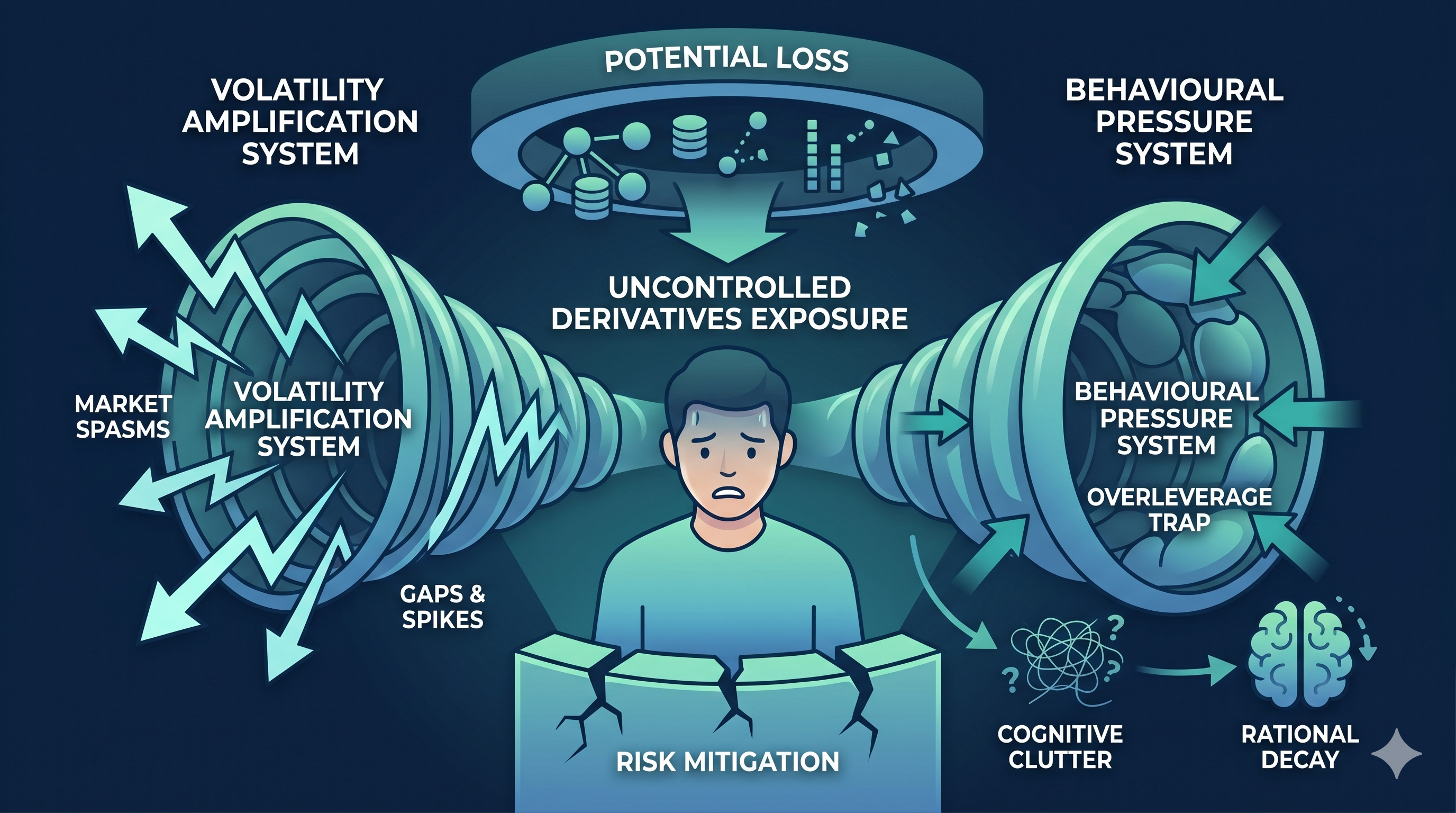
These instruments involve leverage, time sensitivity, volatility expansion, and rapid price fluctuations. Because of this, emotional pressure increases significantly.
Short-term environments compress decision-making timeframes. Reactions become faster. Emotional intensity becomes higher.
For beginners, this structure can become mentally exhausting.
A small market movement may create disproportionately large emotional reactions because derivatives amplify behavioural stress.
Market Context (India-specific)
India has become one of the most active derivatives markets globally in terms of trading activity.
Retail participation in options trading has increased sharply, especially among younger participants entering through mobile-first platforms.
The Securities and Exchange Board of India has repeatedly highlighted the importance of risk awareness and informed participation regarding derivatives activity.
Despite this, many beginners are exposed to short-form content that presents derivatives as simplified market instruments.
This creates a dangerous mismatch between perception and reality.
Behavioural Considerations
Fast-moving environments often encourage impulsive behaviour.
Some beginners begin checking market movement continuously throughout the day. Others become emotionally attached to short-term fluctuations.
Emotional fatigue starts building slowly.
In many cases, inconsistency is not caused by lack of effort. It is caused by constant psychological pressure created by rapid market exposure without sufficient conceptual preparation.
Over time, this weakens behavioural discipline and increases confusion.
THE GAP BETWEEN LEARNING AND MARKET PARTICIPATION
Structural Characteristics
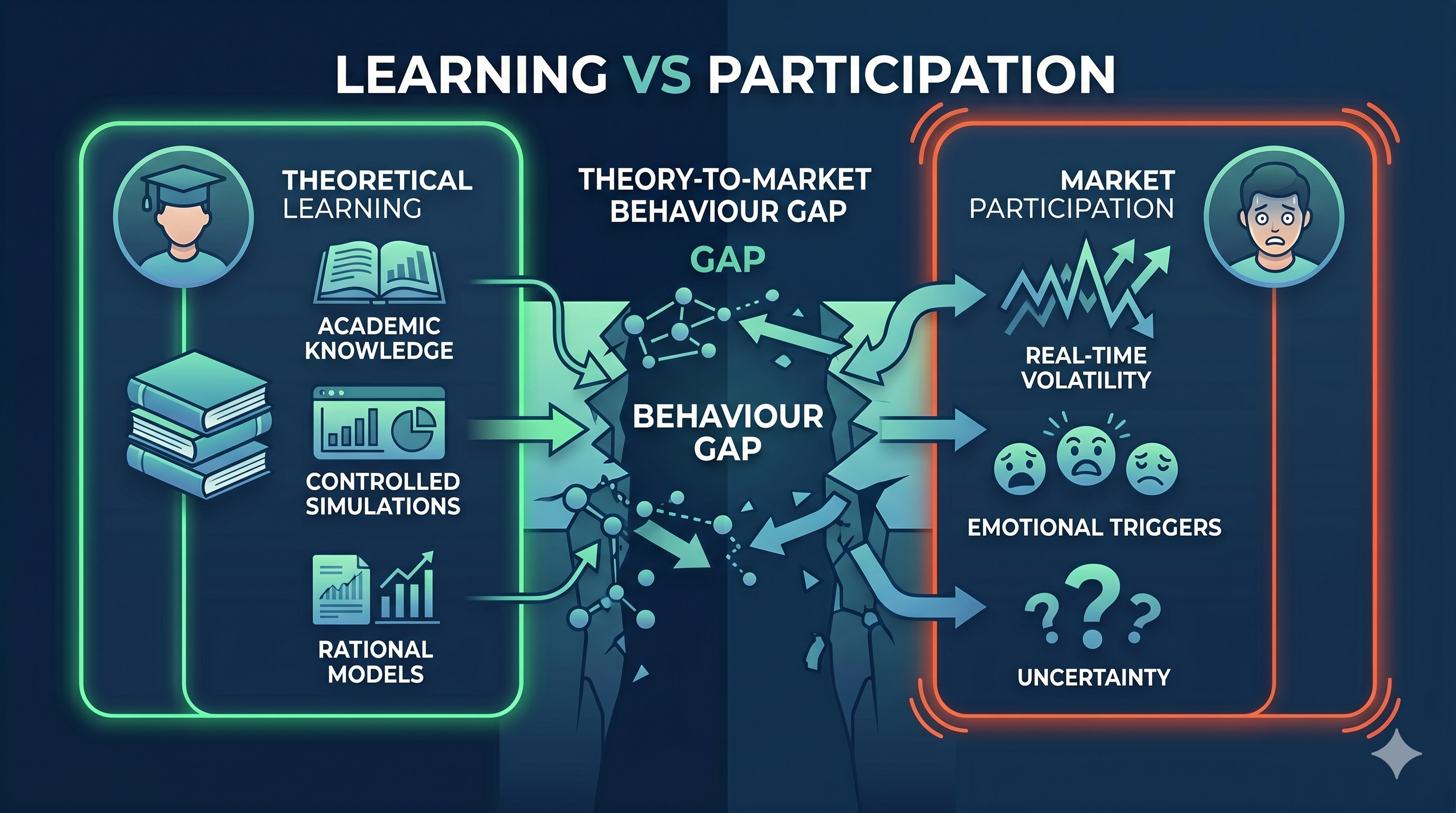
There is a major difference between learning about markets and functioning inside markets.
Watching educational content may improve familiarity with terminology. However, real market environments involve uncertainty, emotional fluctuation, incomplete information, and changing conditions.
This gap surprises many beginners.
A person may understand concepts theoretically but still struggle behaviourally in live market environments.
Financial markets also provide irregular feedback. Sometimes behaviour appears correct but outcomes differ. At other times, poor decisions may temporarily appear justified.
This inconsistency makes self-evaluation difficult.
Market Context (India-specific)
India’s financial education ecosystem has expanded rapidly through YouTube channels, online communities, webinars, and social media platforms.
While educational accessibility has improved, the quality and depth of information remain inconsistent.
Many retail participants consume disconnected concepts without understanding how market structure, liquidity, institutional participation, and behavioural finance interact together.
As a result, learning becomes fragmented.
Behavioural Considerations
Beginners often underestimate the emotional side of markets.
They focus heavily on charts and indicators but ignore behavioural pressure, expectation management, and cognitive overload.
Another common issue is comparison behaviour.
A participant sees someone else discussing aggressive market activity online and starts questioning their own understanding. This creates internal pressure and unstable behaviour.
Professional environments generally focus more on process discipline and risk awareness than public market discussions suggest.
That distinction is important.
COMPARISON TABLE
| Concept | Core Issue | Market Impact | Learning Challenge |
|---|---|---|---|
| Information Overload | Excessive fragmented content | Reactive behaviour | Difficulty building clarity |
| Market Uncertainty | Expectation of predictability | Emotional instability | Understanding probability |
| Derivatives Exposure | High volatility and leverage | Increased behavioural pressure | Limited conceptual awareness |
| Learning vs Participation | Difference between theory and behaviour | Inconsistent reactions | Difficulty adapting to uncertainty |
KEY TAKEAWAYS
- Consistency is more connected to behavioural stability than predictable market outcomes.
- Financial markets remain uncertain despite increasing access to information.
- Rapid retail participation growth in India has increased exposure to complex market instruments.
- Derivatives environments can intensify emotional and behavioural pressure for beginners.
- Educational understanding improves awareness, but it does not remove uncertainty or behavioural limitations.
COMMON BEGINNER MISTAKES
- Expecting certainty from market concepts or indicators.
- Consuming excessive information without structured understanding.
- Frequently changing market approaches due to emotional reactions.
- Confusing short-term movement with complete market understanding.
- Ignoring behavioural pressure while focusing only on charts.
- Comparing personal understanding with online market narratives.
LIMITATIONS
Understanding consistency challenges cannot simplify the financial markets into fixed systems.
Markets continue changing based on liquidity, macroeconomic developments, institutional participation, and behavioural reactions. No concept can fully remove uncertainty from market participation.
Educational awareness may improve conceptual clarity, but it cannot eliminate emotional pressure or behavioural fluctuation.
In professional market environments, behavioural stability is generally viewed as a long-term developmental process rather than a quick learning outcome.
RISK AWARENESS
The Securities and Exchange Board of India regularly emphasizes investor awareness, derivatives risk understanding, and informed participation across Indian financial markets.
The Reserve Bank of India also highlights financial stability concerns, liquidity conditions, and macroeconomic uncertainty through policy communication and financial stability reports.
Financial markets remain uncertain systems. Economic events, institutional positioning, geopolitical developments, and participant behaviour can influence market conditions rapidly.
No educational framework can remove uncertainty completely.
WHAT THIS DOES NOT DO
Understanding why beginners struggle with consistency does not create predictable market behaviour.
Learning market concepts does not guarantee behavioural stability. Similarly, behavioural discipline does not remove uncertainty from financial markets.
This article is intended only to improve financial literacy and conceptual awareness. It does not promote market participation or provide trading advice.
BEGINNER EDUCATIONAL PROGRESSION
- Understand how Indian stock exchanges and financial markets function structurally.
- Learn the role of different market participants and institutional activity.
- Develop conceptual awareness of derivatives, volatility, and liquidity.
- Study behavioural finance and emotional decision-making under uncertainty.
- Build financial literacy gradually through regulated and structured educational sources.
FAQ SECTION
What does consistency actually mean in trading?
Consistency generally refers to stable behaviour and structured participation under changing market conditions. It does not mean predictable outcomes.
Why do beginners feel mentally exhausted in markets?
Continuous information flow, emotional pressure, and uncertainty can create cognitive overload for inexperienced participants.
Why are derivatives difficult for many beginners?
Derivatives involve leverage, rapid price movement, and time sensitivity. These characteristics increase complexity and behavioural pressure.
Does more information automatically improve market understanding?
Not always. Excessive fragmented information can sometimes increase confusion instead of clarity.
Why do many beginners keep changing strategies?
Frequent strategy switching is often connected to uncertainty, emotional reactions, and unrealistic expectations from markets.
What is SEBI’s role in investor education?
The Securities and Exchange Board of India conducts investor awareness initiatives and promotes informed market participation through educational communication and regulatory oversight.
AUTHOR
Vicky Mehta is a stock market trainer with over 20+ years in financial markets and the founder of Succinct Learning Platforms Pvt. Ltd.
He holds an MBA in Financial Markets in collaboration with NSE Academy and is an NSE Certified Market Professional.
His work focuses on structured financial education, risk management frameworks, and disciplined market understanding.
SOURCES
- Securities and Exchange Board of India – Investor Awareness and Protection educational material
- National Stock Exchange of India – Market participation and derivatives activity data
- Reserve Bank of India – Financial Stability Reports and macroeconomic publications
DISCLAIMER
This article is intended solely for educational and informational purposes.
It does not constitute investment advice, trading guidance, research recommendation, or solicitation to participate in financial markets.
Readers should consult a SEBI-registered investment advisor or qualified financial professional before making financial decisions.
The purpose of this content is limited to improving financial literacy and conceptual understanding of financial market behaviour.
other related topic
Why do most traders lose money in stock market
I’ve started sharing structured trading insights here.
If you’re still trying to understand markets properly, this will help
[trading seekho whatsapp channel]