

Published: May 2026
Last Updated: April 2026
INTRODUCTION
India’s financial markets have seen a major rise in retail participation over the last few years. More people are opening trading accounts, following market discussions online, and exploring instruments listed on the National Stock Exchange of India and Bombay Stock Exchange.
For many beginners, the journey starts with curiosity.
Someone watches market videos on YouTube. Someone hears friends discussing options trading. Others enter after seeing screenshots of fast-moving charts on social media. The market begins to look accessible, active, and easy to follow.
But after spending some time in real market conditions, many beginners experience something completely different.
Trading starts feeling confusing.
A setup that looked clear yesterday suddenly stops making sense today. One expert explains the market in one direction, while another presents the exact opposite view. A person studies charts for weeks, yet still feels uncertain while observing live market movement.
This confusion is not always caused by lack of effort. In many cases, it develops because beginners underestimate how complex financial markets actually are.
The Securities and Exchange Board of India regularly highlights the importance of investor awareness, risk understanding, and informed participation. However, a large amount of public market content focuses more on speed and activity than on structure and interpretation.
This article is written purely for educational purposes. Its objective is to explain why trading feels confusing for many beginners and how information overload, uncertainty, behavioural pressure, and market structure contribute to that experience.
WHY THIS TOPIC MATTERS FOR LEARNERS
Many beginners assume confusion exists because they have not yet found the “right strategy” or “perfect indicator.” That belief creates a continuous cycle of searching.
One week a person studies indicators. The next week they move toward price action. After that, they start watching derivatives discussions or macroeconomic analysis. Information keeps increasing, but clarity often does not.
This topic matters because confusion in financial markets is rarely caused by one single issue.
Markets are dynamic systems. Liquidity changes. Participant behaviour changes. News flow changes. Institutional positioning changes. A beginner entering this environment without understanding these layers can easily feel mentally overloaded.
A common observation in the Indian retail market environment is that many participants spend more time consuming financial content than understanding how markets structurally function. They continuously watch opinions, predictions, and chart discussions throughout the day, yet still struggle to interpret market movement independently.
That creates frustration.
Over time, confusion slowly shifts from a temporary feeling to a behavioural pattern. A person starts doubting every concept after short-term market fluctuations. Confidence becomes dependent on external opinions instead of structured understanding.
Understanding this topic conceptually is important because it helps learners recognize that financial markets cannot be reduced to fixed formulas or predictable reactions.
1. What Is Trading Confusion?
Trading confusion refers to difficulty interpreting market behaviour, price movement, or financial information in a stable and structured manner. It often develops when expectations, information flow, and live market conditions do not align consistently.
In educational contexts, trading confusion is commonly linked to uncertainty, fragmented learning, and behavioural instability.
2. What Is Behavioural Overload in Financial Markets?
Behavioural overload refers to mental and emotional pressure created by excessive market exposure, conflicting information, and continuous interpretation demands.
In financial markets, this may appear through impulsive reactions, unstable thinking, excessive chart-checking behaviour, or constant switching between market views.
EXPLANATION
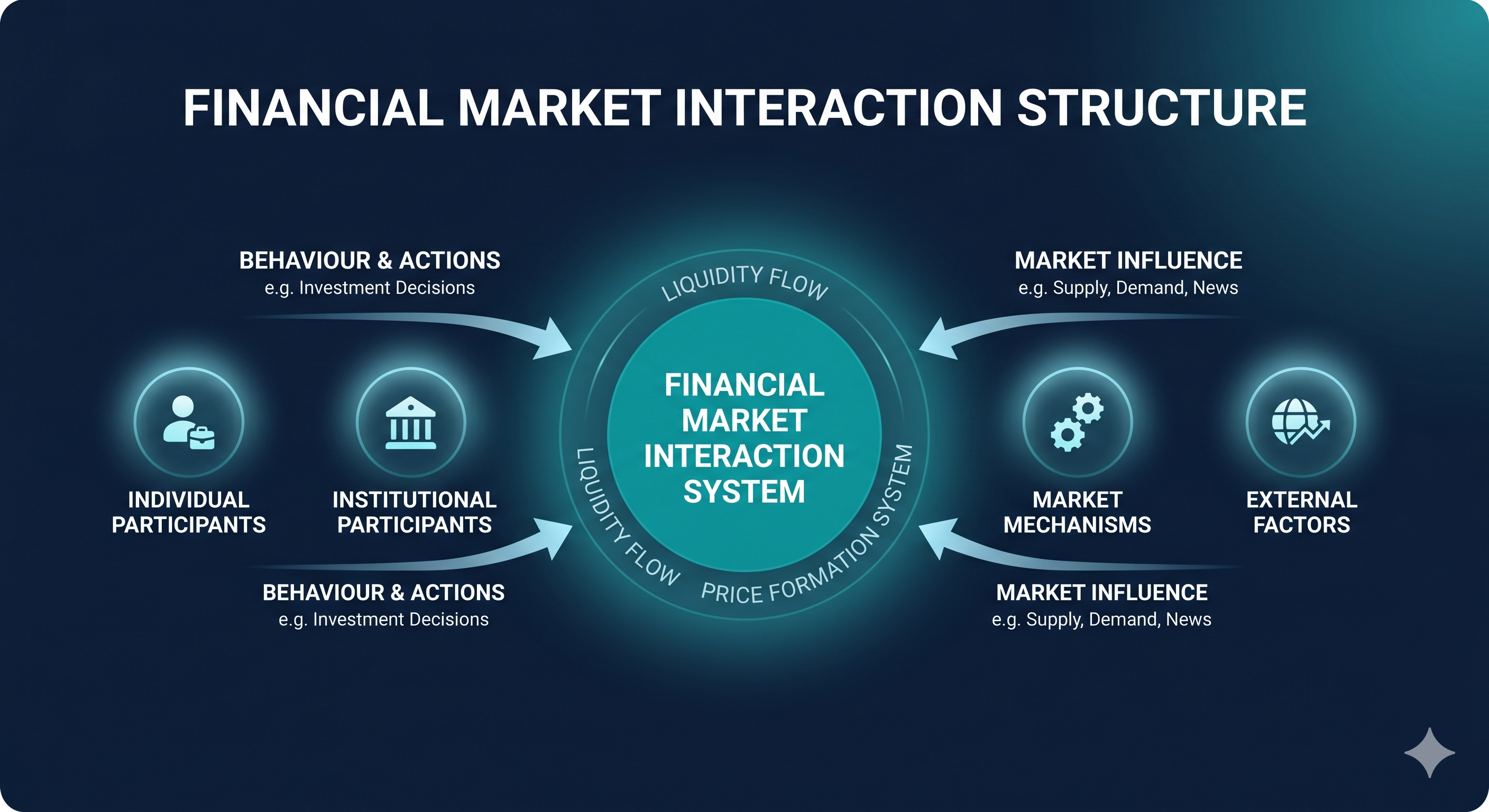
Financial markets operate through interaction between multiple participant groups at the same time. Institutions, retail traders, mutual funds, foreign investors, hedging participants, and algorithmic systems all influence market behaviour differently.
Because of this, market movement rarely follows one simple explanation.
Beginners often enter markets expecting clear logic and fixed patterns. In reality, markets respond to liquidity changes, economic data, policy developments, institutional positioning, global events, and participant psychology simultaneously.
That complexity creates interpretation pressure.
A beginner may spend days studying one concept and still feel confused when the market behaves differently in live conditions. This does not always mean the concept is incorrect. It often reflects the changing nature of financial systems.
Research in behavioural finance has repeatedly shown that uncertainty and emotional pressure influence human interpretation and decision-making under dynamic conditions.
The challenge for beginners is therefore larger than learning chart terminology or indicators. The real challenge is understanding how multiple variables interact together inside uncertain market environments.
INFORMATION OVERLOAD AND CONSTANT MARKET NOISE
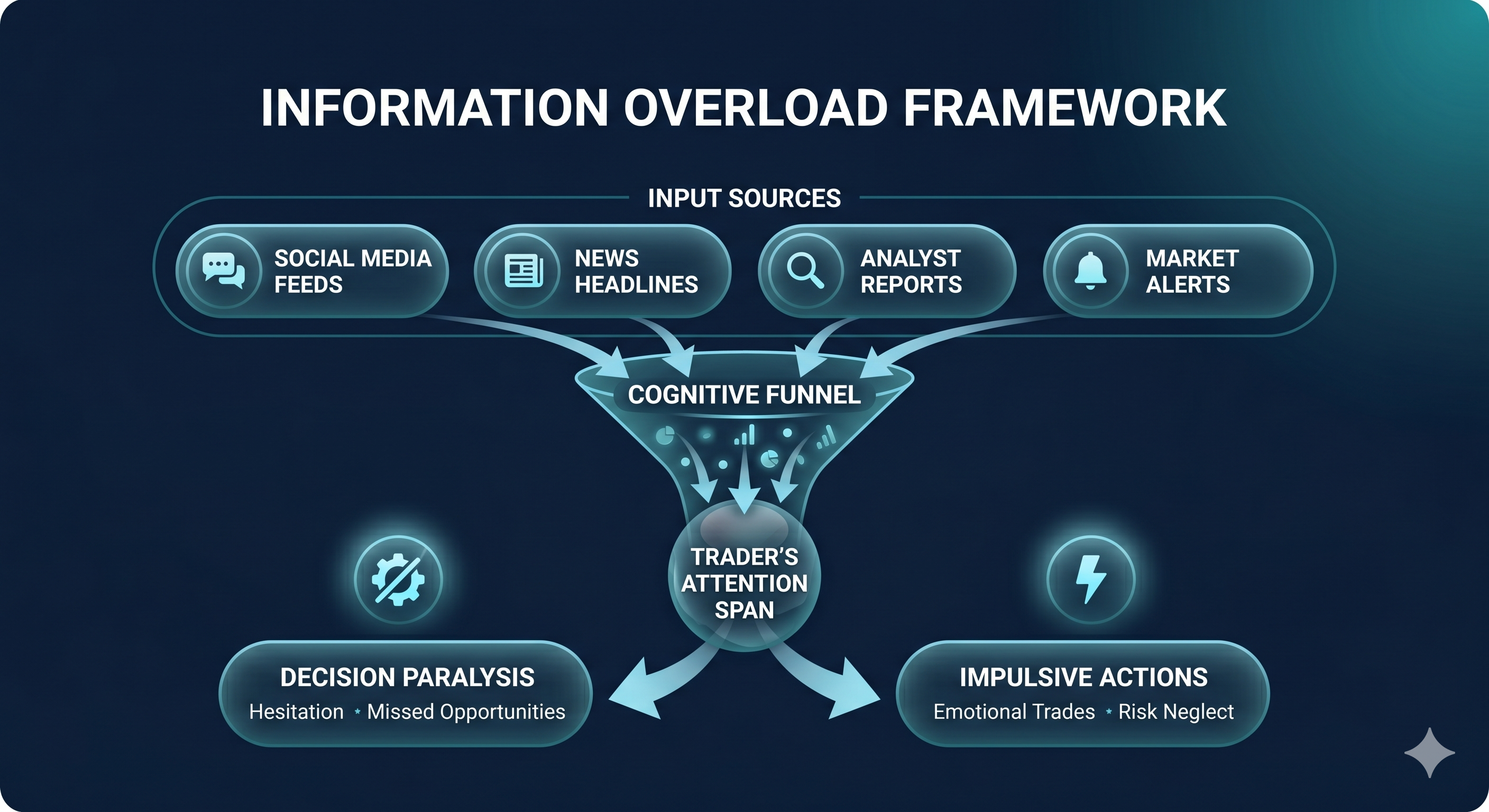
Structural Characteristics
Modern market participants are exposed to nonstop information.
Charts, indicators, news updates, options data, economic announcements, and social media discussions appear continuously throughout the day. Initially, this feels educational. Over time, however, excessive exposure can reduce clarity instead of improving it.
A beginner may hear one person discussing bullish sentiment while another explains bearish expectations in the same market environment. One educator focuses entirely on indicators, while another rejects indicators completely.
This creates fragmented interpretation.
The problem becomes bigger when concepts are consumed without broader context. Terms like “support,” “breakout,” “trend,” or “option chain” may appear repeatedly online, but beginners often struggle to understand how these ideas connect within actual market structure.
Market Context (India-specific)
India’s digital trading ecosystem has expanded rapidly. Mobile-first trading platforms, simplified interfaces, and low brokerage structures have made financial market participation easier than ever before.
At the same time, derivatives participation among retail traders on the National Stock Exchange of India has increased significantly.
Many beginners now enter highly active market environments before fully understanding concepts such as volatility, liquidity behaviour, or institutional participation.
As accessibility grows faster than conceptual understanding, confusion naturally increases.
Behavioural Considerations
Excessive information often creates dependency rather than understanding.
Some beginners begin changing their market interpretation after every small movement. Others repeatedly shift between concepts because they no longer know what to trust.
Slowly, confidence becomes linked to external opinions.
This creates unstable behaviour. A person may spend hours watching charts, checking market updates repeatedly, or searching for confirmation from multiple sources. Instead of reducing uncertainty, the behaviour increases mental exhaustion.
MISUNDERSTANDING UNCERTAINTY IN FINANCIAL MARKETS
Structural Characteristics
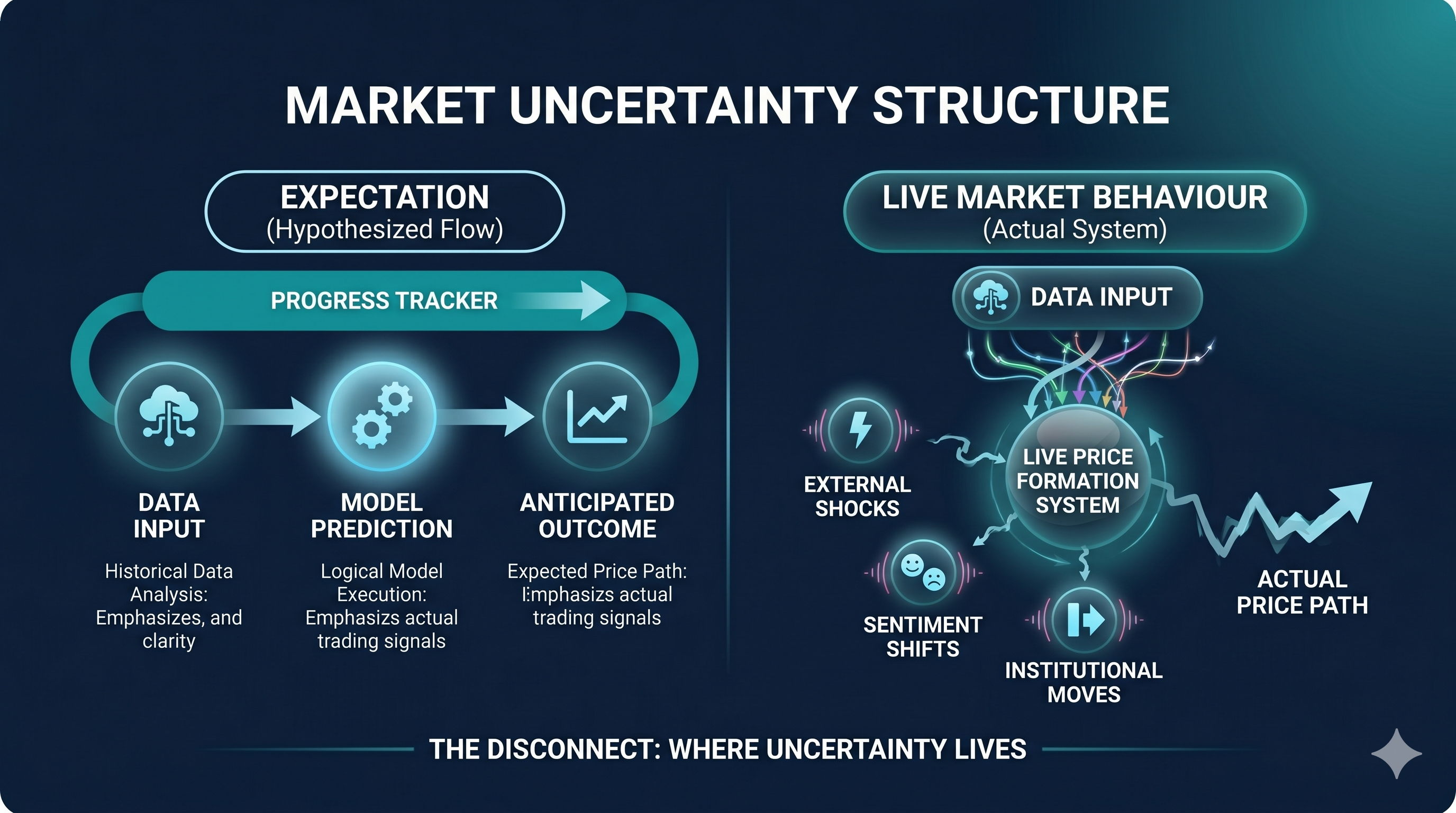
Many beginners believe markets should eventually become predictable after enough learning exposure.
That expectation creates frustration.
Financial markets are probability-driven systems influenced by economic conditions, institutional activity, liquidity flow, global developments, and participant behaviour. No framework can remove uncertainty completely.
The same market structure may behave differently under different conditions because participation and sentiment continuously change.
This is not a flaw in markets. It is part of how financial systems function.
Market Context (India-specific)
A large number of Indian retail participants entered markets during periods of strong market visibility and rising public interest.
During such phases, markets may appear simpler than they actually are.
However, Indian financial markets are deeply connected to domestic policy decisions, inflation expectations, institutional capital movement, and global economic developments. Announcements from the Reserve Bank of India or international central banks can rapidly influence market sentiment and volatility.
Beginners who are unaware of these interconnected influences often struggle emotionally when markets behave unexpectedly.
Behavioural Considerations
Human beings naturally search for certainty and stable patterns.
That tendency becomes difficult in markets because uncertainty never fully disappears.
When beginners expect certainty from indicators, opinions, or chart patterns, emotional frustration increases during unpredictable market conditions. Some participants begin changing systems repeatedly. Others start following random market narratives online.
Over time, confusion grows not because information is missing, but because uncertainty is misunderstood.
DERIVATIVES EXPOSURE AND SHORT-TERM REACTION CYCLES
Structural Characteristics
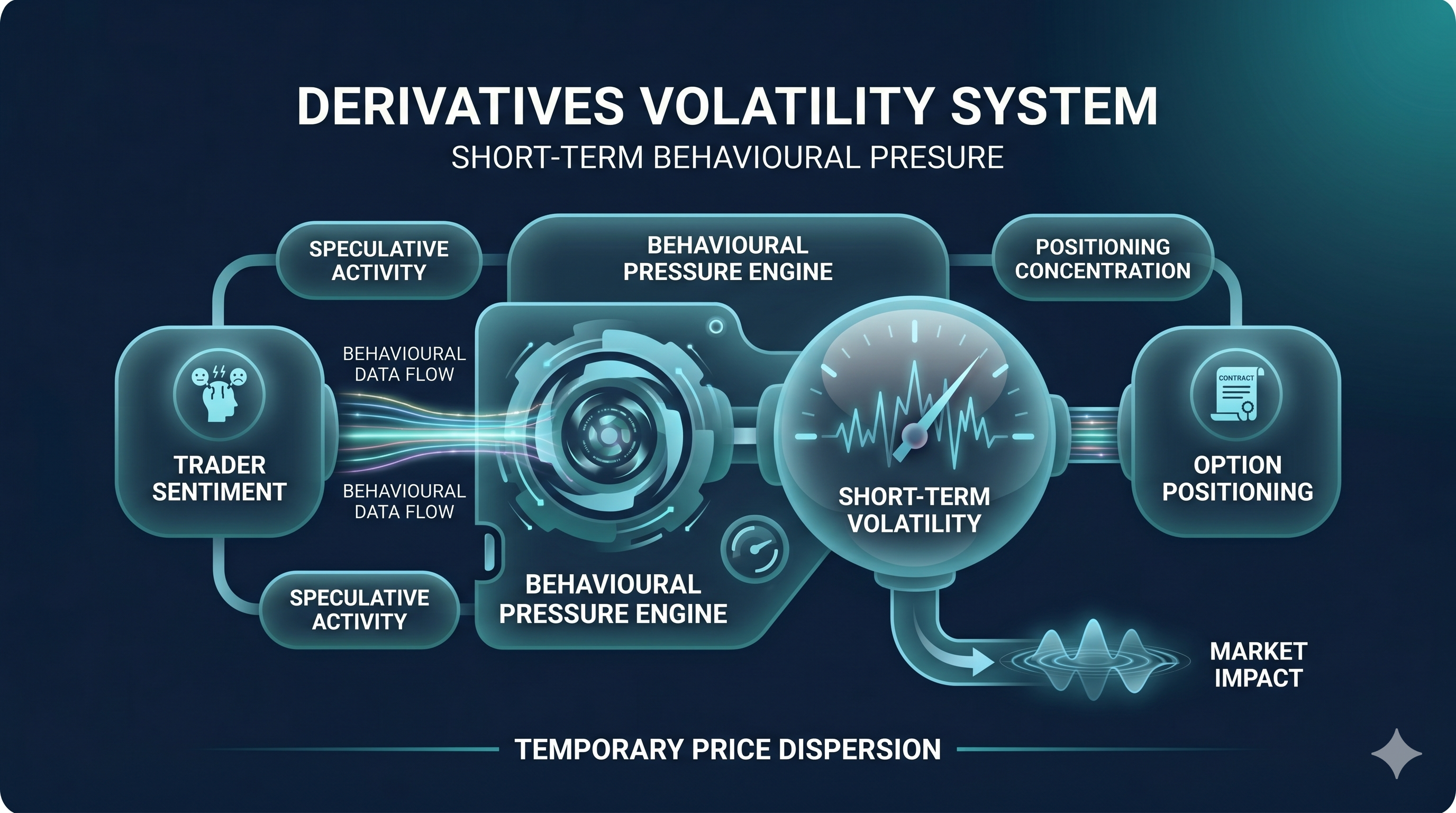
Derivatives markets involve leverage, volatility concentration, and time-sensitive behaviour. These structural characteristics create faster movement and shorter reaction cycles compared to many cash market environments.
For beginners, this can become mentally demanding.
Small fluctuations in the underlying market may create larger emotional reactions because derivatives amplify behavioural pressure. Rapid movement compresses decision-making timeframes and increases interpretation stress.
This structure makes emotional stability more difficult for inexperienced participants.
Market Context (India-specific)
India has become one of the world’s largest derivatives markets by trading activity. Retail participation in options trading has expanded sharply through mobile-based accessibility and simplified trading interfaces.
The Securities and Exchange Board of India has repeatedly emphasized investor awareness and derivatives risk understanding.
Despite this, many beginners are introduced to derivatives through short-form content, fragmented online discussions, or rapid market commentary instead of structured educational frameworks.
This creates a major gap between market perception and actual complexity.
Behavioural Considerations
Fast-moving derivatives environments can increase impulsive reactions.
Some beginners begin checking charts continuously throughout the day. Others become emotionally attached to short-term market fluctuations. Mental fatigue starts building gradually.
In many situations, confusion develops not because markets are impossible to understand, but because emotional pressure disrupts structured observation and stable interpretation.
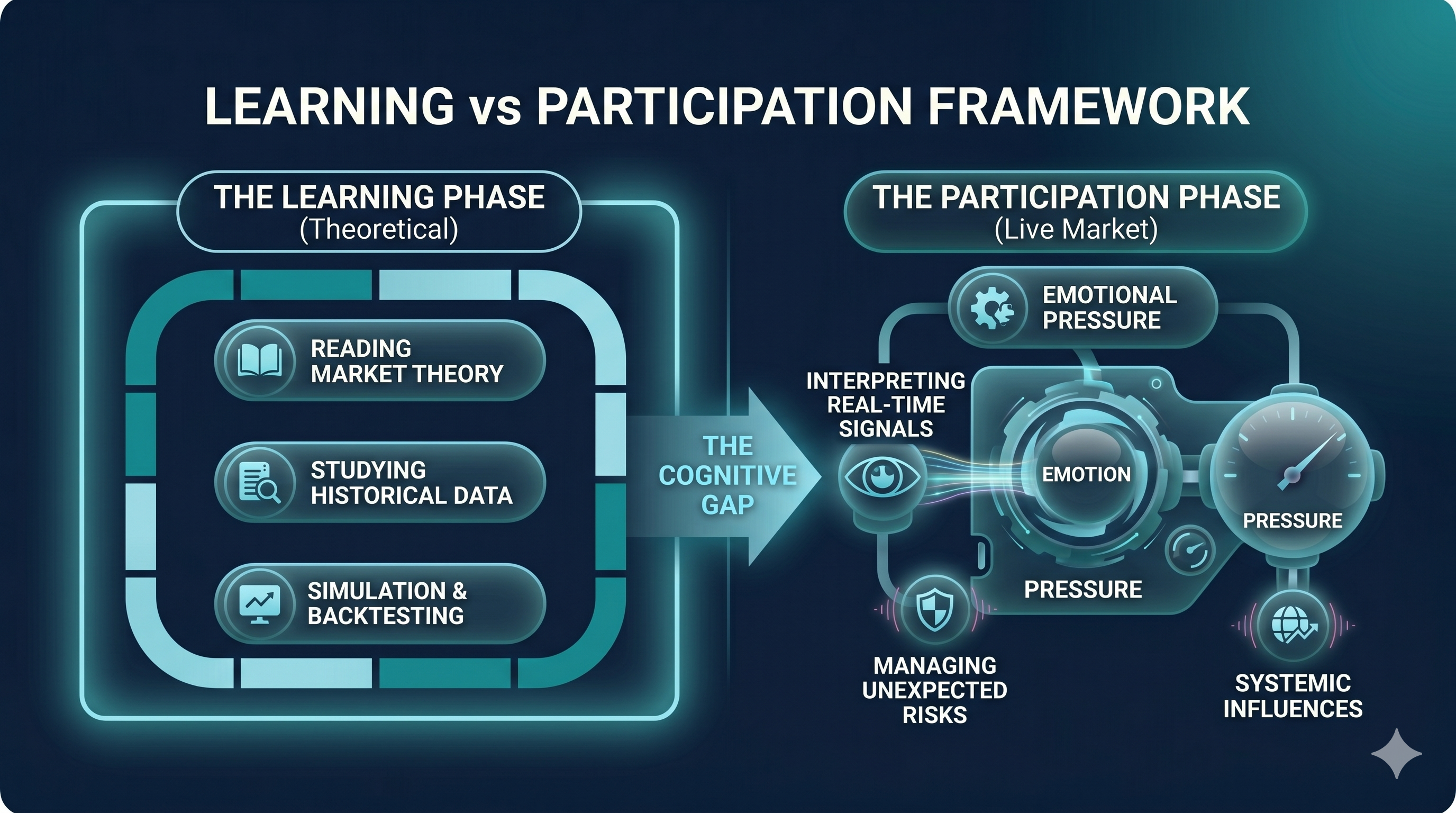
THE GAP BETWEEN LEARNING AND REAL MARKET PARTICIPATION
Structural Characteristics
There is a significant difference between understanding market concepts theoretically and observing live market behaviour in real-time conditions.
Educational material is usually structured and simplified for explanation purposes. Live financial markets are different. They involve uncertainty, conflicting information, rapid behavioural shifts, and incomplete interpretation.
This gap surprises many beginners.
A chart pattern may appear simple during study sessions but become difficult to interpret in active market conditions where multiple variables interact simultaneously.
Market Context (India-specific)
India’s financial education ecosystem has expanded rapidly across webinars, social media platforms, online communities, and video-based learning channels.
Access to information has improved considerably. However, conceptual depth remains inconsistent across many public discussions.
Retail participants often consume disconnected fragments of financial education without fully understanding how liquidity, institutional participation, behavioural finance, and macroeconomic developments connect together.
This fragmented learning environment increases confusion during real market participation.
Behavioural Considerations
Beginners frequently focus heavily on technical concepts while underestimating behavioural pressure.
Emotional reactions, uncertainty, comparison behaviour, and cognitive overload can influence interpretation more strongly than expected. A participant may understand a concept academically yet still feel confused while observing live market conditions.
Professional market environments generally emphasize behavioural stability and structured observation more than public market discussions suggest.
That distinction is important for long-term financial literacy.
COMPARISON TABLE
| Concept | Core Issue | Market Impact | Learning Challenge |
|---|---|---|---|
| Information Overload | Excessive fragmented content | Reactive interpretation | Difficulty building conceptual clarity |
| Market Uncertainty | Expectation of predictability | Emotional instability | Understanding probability-driven systems |
| Derivatives Exposure | High volatility and leverage | Increased behavioural pressure | Difficulty interpreting rapid movement |
| Learning vs Participation | Difference between theory and live markets | Unstable market interpretation | Adapting to uncertain environments |
KEY TAKEAWAYS
- Trading confusion is often connected to structural and behavioural misunderstanding rather than lack of intelligence.
- Financial markets operate through uncertainty, changing participation, and dynamic information flow.
- Rapid retail participation growth in India has increased exposure to complex market environments.
- Derivatives activity can amplify emotional pressure and unstable interpretation cycles among beginners.
- Educational understanding improves awareness, but it cannot remove uncertainty from financial markets.
COMMON BEGINNER MISTAKES
- Expecting markets to behave predictably after limited learning exposure.
- Consuming excessive financial content without conceptual integration.
- Changing market interpretation after every short-term fluctuation.
- Depending heavily on online opinions instead of structural understanding.
- Ignoring behavioural pressure while focusing only on technical concepts.
- Assuming more information automatically creates clarity.
LIMITATIONS
Understanding why trading feels confusing cannot remove uncertainty from financial markets.
Market behaviour continues changing because liquidity conditions, institutional activity, macroeconomic developments, and participant psychology continuously evolve. No educational framework can simplify markets into fixed or fully predictable systems.
Educational awareness may improve conceptual understanding, but it cannot eliminate emotional pressure or behavioural fluctuation during uncertain market conditions.
In professional financial environments, interpretation stability is generally viewed as a gradual developmental process rather than a short-term educational outcome.
RISK AWARENESS
The Securities and Exchange Board of India regularly emphasizes investor awareness, informed participation, and derivatives risk understanding across Indian financial markets.
The Reserve Bank of India also highlights financial stability concerns, liquidity conditions, inflation trends, and macroeconomic uncertainty through policy communication and Financial Stability Reports.
Financial markets remain uncertain systems influenced by domestic developments, global events, institutional positioning, and behavioural reactions. No educational process can remove uncertainty completely.
WHAT THIS DOES NOT DO
Understanding why trading feels confusing does not create predictable market outcomes.
Learning financial concepts does not guarantee stable interpretation during live market conditions. Similarly, behavioural discipline does not eliminate uncertainty from financial systems.
This article exists only to improve financial literacy and conceptual awareness regarding market structure and participant behaviour.
BEGINNER LEARNING PATH
- Understand how Indian financial markets and exchanges function structurally.
- Learn the role of institutional participants, retail traders, and liquidity behaviour.
- Develop conceptual awareness of derivatives, volatility, and market uncertainty.
- Study behavioural finance and emotional interpretation under uncertain conditions.
- Build financial literacy gradually through structured and regulated educational material.
FAQ SECTION
Why does trading feel confusing for beginners?
Financial markets involve uncertainty, changing behaviour, multiple participant interactions, and continuous information flow. This combination can make interpretation difficult for inexperienced participants.
What creates information overload in trading?
Excessive exposure to charts, indicators, market news, social media discussions, and conflicting opinions can create fragmented understanding and cognitive confusion.
Why do beginners struggle during volatile market conditions?
Volatile environments increase emotional pressure, uncertainty, and rapid interpretation demands, especially within derivatives markets.
Does learning more indicators reduce market confusion?
Not necessarily. Without broader conceptual understanding, additional information can sometimes increase confusion instead of improving clarity.
Why do markets behave differently even when concepts appear similar?
Financial markets are dynamic systems influenced by liquidity, participant behaviour, macroeconomic developments, and institutional activity, all of which continuously change market conditions.
What role does SEBI play in investor education?
The Securities and Exchange Board of India conducts investor awareness initiatives and promotes informed financial participation through educational and regulatory frameworks.
AUTHOR
Vicky Mehta is a stock market trainer with over 20+ years in financial markets and the founder of Succinct Learning Platforms Pvt. Ltd.
He holds an MBA in Financial Markets in collaboration with NSE Academy and is an NSE Certified Market Professional.
His work focuses on structured financial education, risk management frameworks, and disciplined market understanding.
SOURCES
- Securities and Exchange Board of India – Investor Awareness and Protection educational material
- National Stock Exchange of India – Market participation and derivatives activity data
- Reserve Bank of India – Financial Stability Reports and macroeconomic publications
DISCLAIMER
This article is intended solely for educational and informational purposes.
It does not constitute investment advice, trading guidance, research recommendation, or solicitation to participate in financial markets.
Readers should consult a SEBI-registered investment advisor or qualified financial professional before making financial decisions.
The purpose of this content is limited to improving financial literacy and conceptual understanding of financial market behaviour.
Why Many Beginners Struggle With Consistency in Trading
I’ve started sharing structured trading insights here.
If you’re still trying to understand markets properly, this will help