

Published: June 2026
Last Updated: June 2026
INTRODUCTION
Many beginners enter financial markets believing that understanding trading primarily involves learning charts, indicators, patterns, or market analysis. However, professional market participants, exchanges, regulators, and financial institutions often devote significant attention to a different subject: risk.
This difference in focus can seem confusing at first. If financial markets are designed around buying and selling assets, why do market participants spend so much time discussing risk management?
The answer lies in the nature of financial markets themselves. Markets operate in environments where future outcomes remain uncertain. Prices are influenced by economic developments, company-specific information, global events, liquidity conditions, participant behaviour, and countless other variables that interact continuously.
As retail participation continues to expand across the Indian financial market ecosystem, understanding risk has become increasingly important from an educational perspective. Activity on the National Stock Exchange (NSE) and the Bombay Stock Exchange (BSE) has grown substantially over recent years, while participation in equity and derivatives markets has also increased. Alongside this growth, the Securities and Exchange Board of India has consistently emphasized investor awareness, risk disclosures, and informed participation.
Risk management is therefore not simply a trading-related term. It is a concept that exists throughout the modern financial system. Exchanges use risk frameworks, clearing corporations use risk controls, institutions maintain risk departments, and regulators establish risk-related safeguards to support market integrity.
This article explains what risk management in trading means, why it exists, how it functions conceptually, its relationship with market behaviour, and the limitations learners should understand. The purpose is educational and intended to improve financial literacy rather than promote market participation.
WHY THIS TOPIC MATTERS FOR LEARNERS
Risk management is one of the most frequently mentioned concepts in financial markets, yet it remains one of the least understood by beginners.
A common source of confusion is that many educational discussions focus heavily on market opportunities while spending comparatively less time explaining uncertainty. As a result, learners often encounter the term “risk management” repeatedly without fully understanding its purpose within the broader market structure.
This matters because uncertainty is one of the few characteristics present in every market environment. Regardless of whether markets are rising, falling, or moving sideways, uncertainty continues to exist.
A common observation across retail market discussions is that conversations frequently focus on expected market movement, while considerably less attention is given to understanding what may happen if market conditions change unexpectedly. This imbalance can create misconceptions regarding how financial markets function.
For learners, understanding risk management provides important context for understanding why regulators issue risk disclosures, why exchanges maintain risk-monitoring systems, why institutions establish risk departments, and why market participants often discuss uncertainty alongside opportunity.
Understanding the concept does not remove uncertainty, but it can improve awareness of how modern financial markets are structured and why risk remains a central consideration across all market environments.
What Is Risk Management in Trading?
Risk management in trading refers to the structured process of identifying, assessing, monitoring, and controlling exposure to uncertainty within financial market activities. It serves as a framework for understanding potential adverse outcomes that may arise from changing market conditions.
What Is Market Risk?
Market risk refers to the possibility that the value of a financial asset may change because of movements in prices, volatility, liquidity conditions, economic developments, or broader market events. It is one of the most fundamental forms of uncertainty present within financial markets.
EXPLANATION
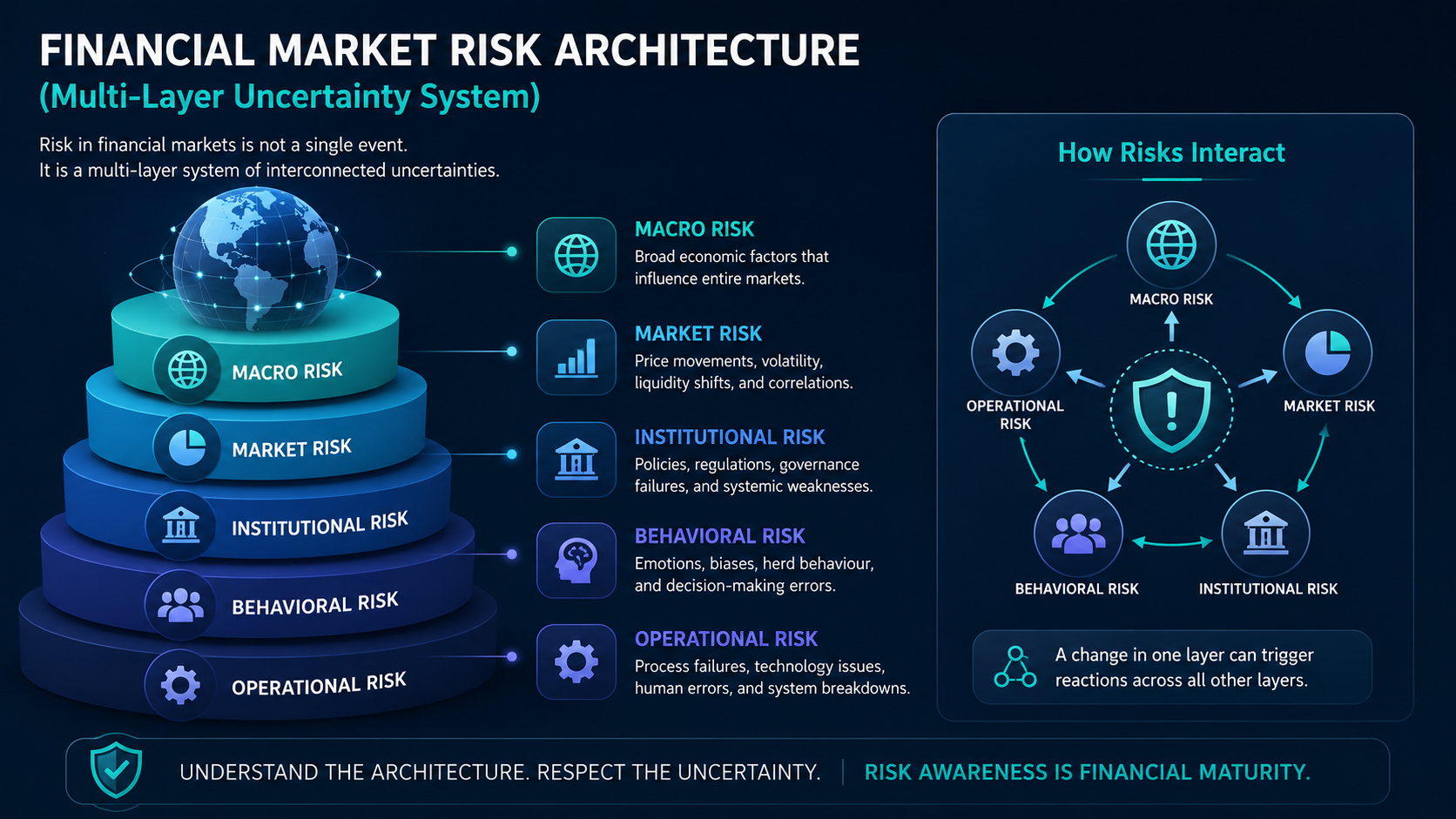
Risk management exists because financial markets operate in uncertain environments. Every market participant, regardless of experience level, interacts with a system where future price movement cannot be known with certainty.
Rather than attempting to eliminate uncertainty, risk management provides a framework for understanding and monitoring exposure to uncertainty. This distinction is important because uncertainty is not a temporary market condition; it is a permanent feature of financial markets.
The concept operates at multiple levels simultaneously.
- Regulators establish market safeguards.
- Exchanges maintain operational risk frameworks.
- Clearing corporations monitor settlement-related risks.
- Brokerage firms maintain operational controls.
- Institutional participants establish internal risk policies.
- Retail participants are exposed to market risk through market activity.
These layers collectively contribute to the broader risk architecture of modern financial markets.
Market participants also play an important role in this process. Buyers, sellers, institutional investors, market makers, hedge participants, and retail traders continuously interact through the price discovery process. Their collective actions influence liquidity, volatility, and market behaviour.
Research across financial markets consistently indicates that uncertainty is an inherent characteristic of market systems rather than an occasional event. Consequently, risk management has evolved into a foundational component of financial market infrastructure worldwide.
Why Risk Management Is Discussed More Than Market Predictions
Many beginners assume that market discussions primarily revolve around predicting future prices. However, professional institutions often place significant emphasis on risk management because predictions can differ widely among participants, while uncertainty remains present regardless of individual opinions.
Different participants may hold different expectations about future market movement. Some may anticipate higher prices, while others may anticipate lower prices. Despite these differences, all participants continue operating within an uncertain environment.
As a result, institutions frequently focus on understanding and monitoring uncertainty rather than attempting to eliminate it. Exchanges maintain surveillance systems, clearing corporations monitor settlement exposures, and regulators establish disclosure requirements because market uncertainty cannot be removed entirely.
This is one reason risk management receives consistent attention across the financial industry. The objective is not to create certainty but to acknowledge uncertainty as a permanent characteristic of market activity.
Risk Management Within Market Infrastructure
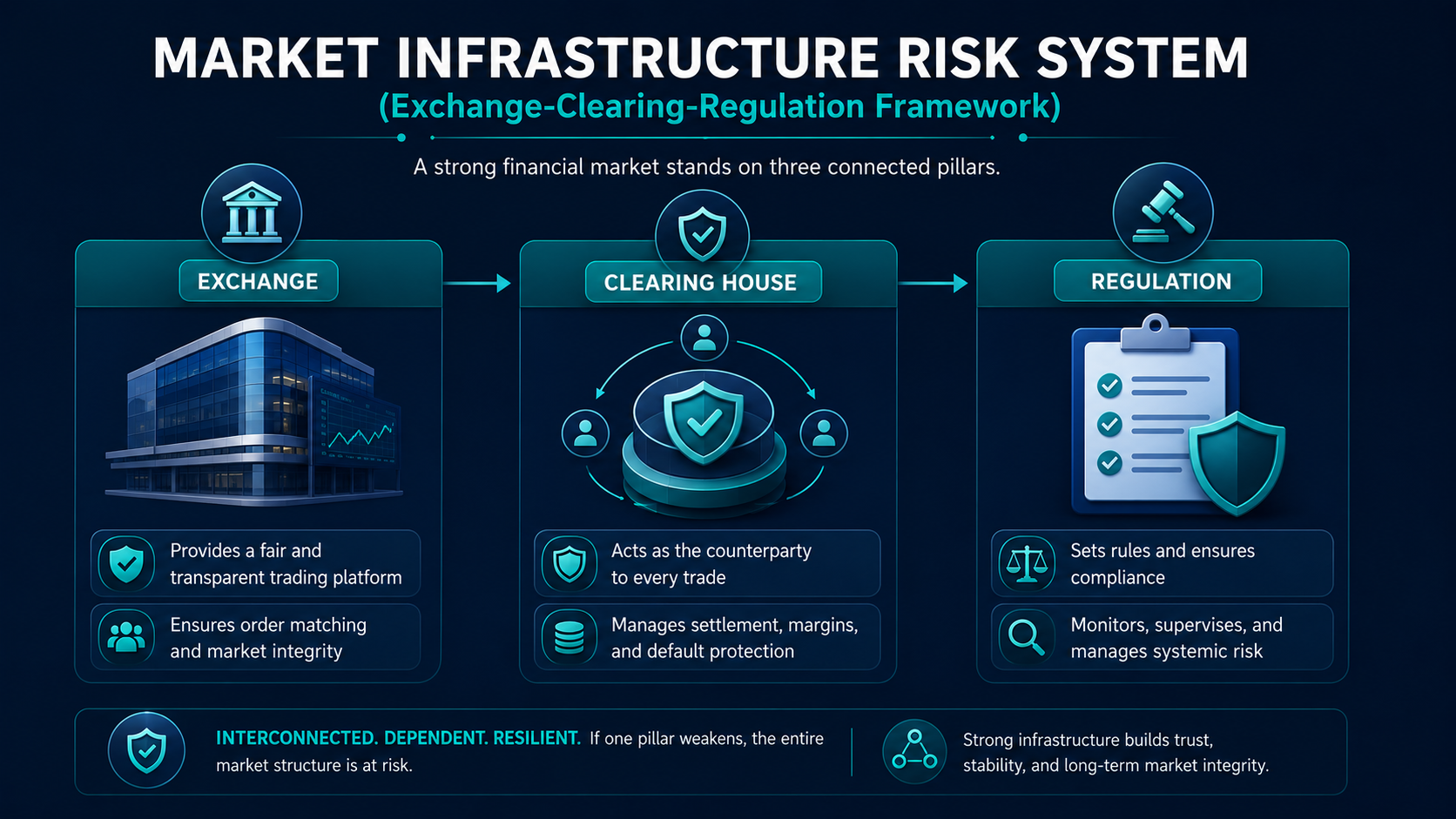
Modern financial markets include several infrastructure components designed to support orderly functioning.
These include:
- Clearing corporations
- Settlement systems
- Margin frameworks
- Surveillance mechanisms
- Regulatory oversight systems
These structures are not designed to predict market outcomes. Instead, they are intended to help manage operational and systemic risks that may arise within market ecosystems.
For learners, understanding the existence of these frameworks provides valuable insight into how financial markets function beyond visible price movement.
CORE EDUCATIONAL SECTIONS
Why Risk Management Exists in Financial Markets
Structural Characteristics
Financial markets function through a process known as price discovery. Prices continuously change as participants interact with one another and respond to new information.
At any given moment, thousands of participants may hold different views regarding valuation, economic conditions, corporate developments, or future expectations. These differing opinions contribute to ongoing market activity and create a dynamic environment where prices adjust continuously.
Because future information cannot be fully known in advance, uncertainty becomes embedded within the market structure itself. Risk management exists partly because financial markets cannot operate without uncertainty.
Market activity is also influenced by numerous interconnected factors, including:
- Economic developments
- Corporate announcements
- Liquidity conditions
- Global market events
- Monetary policy developments
- Participant behaviour
The interaction of these factors creates an environment where outcomes remain uncertain even when significant information is available.
Market Context (India-specific)
India’s financial markets have experienced substantial growth in participation over the last decade. Increased accessibility through digital platforms has enabled a larger number of retail participants to engage with both equity and derivatives markets.
The NSE and BSE serve as central components of India’s capital market ecosystem, facilitating market activity across a broad range of participants.
As participation has expanded, educational efforts surrounding market awareness have also increased. SEBI, exchanges, and market institutions regularly emphasize the importance of understanding market risks and disclosures.
The growth of retail participation has made financial literacy increasingly important because a larger and more diverse participant base now interacts within the market environment.
Behavioural Considerations
Human beings often focus more naturally on potential opportunities than on uncertainty.
Behavioural finance research has documented several tendencies that influence risk perception, including:
- Overconfidence
- Confirmation bias
- Selective attention
- Hindsight bias
These behavioural tendencies can affect how market participants interpret information and evaluate uncertainty.
Understanding risk management conceptually helps learners recognize that uncertainty exists independently of confidence, expectations, or personal beliefs.
Components of Risk in Trading
Structural Characteristics
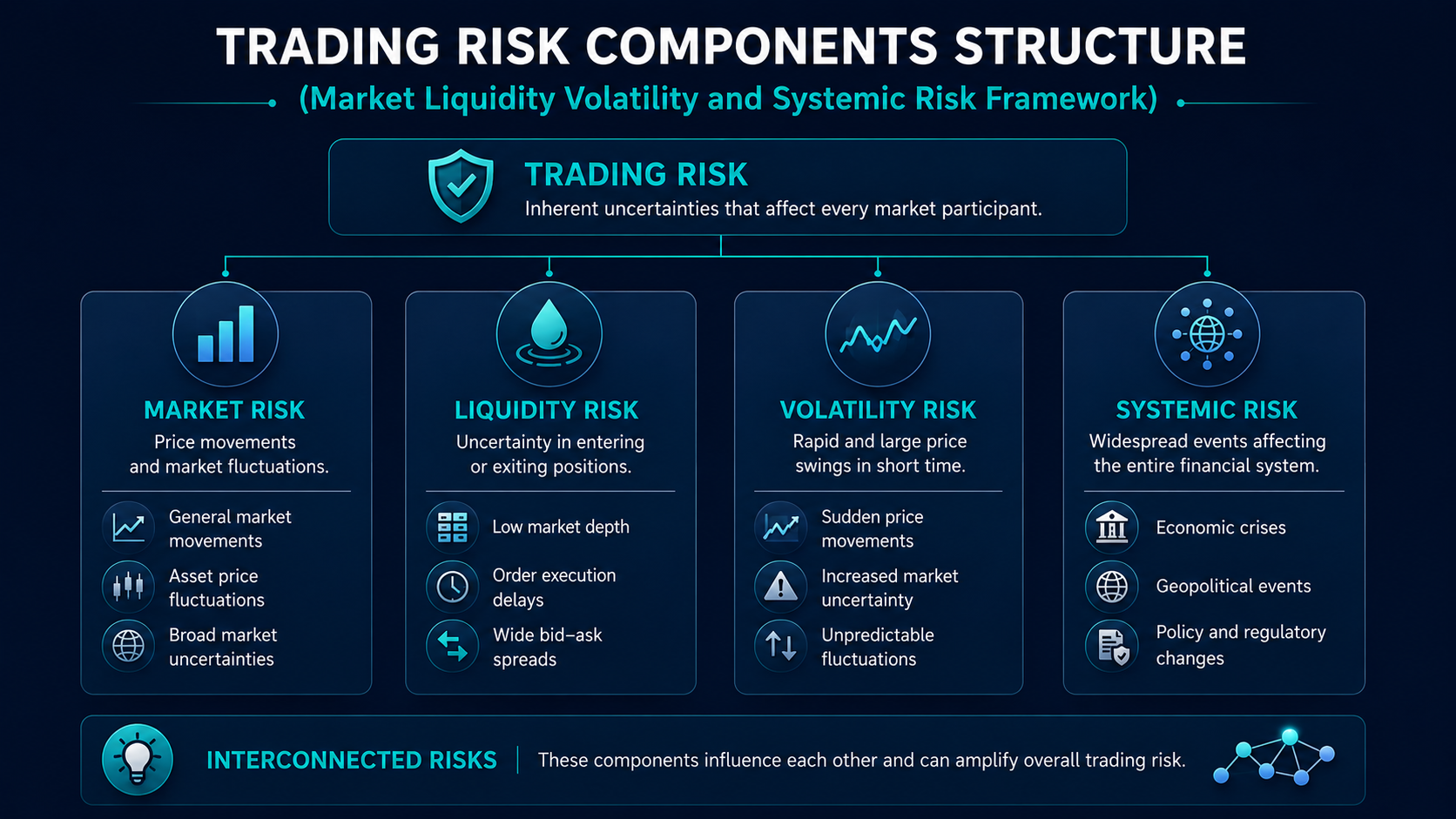
Risk within financial markets does not originate from a single source. Instead, multiple forms of uncertainty may exist simultaneously.
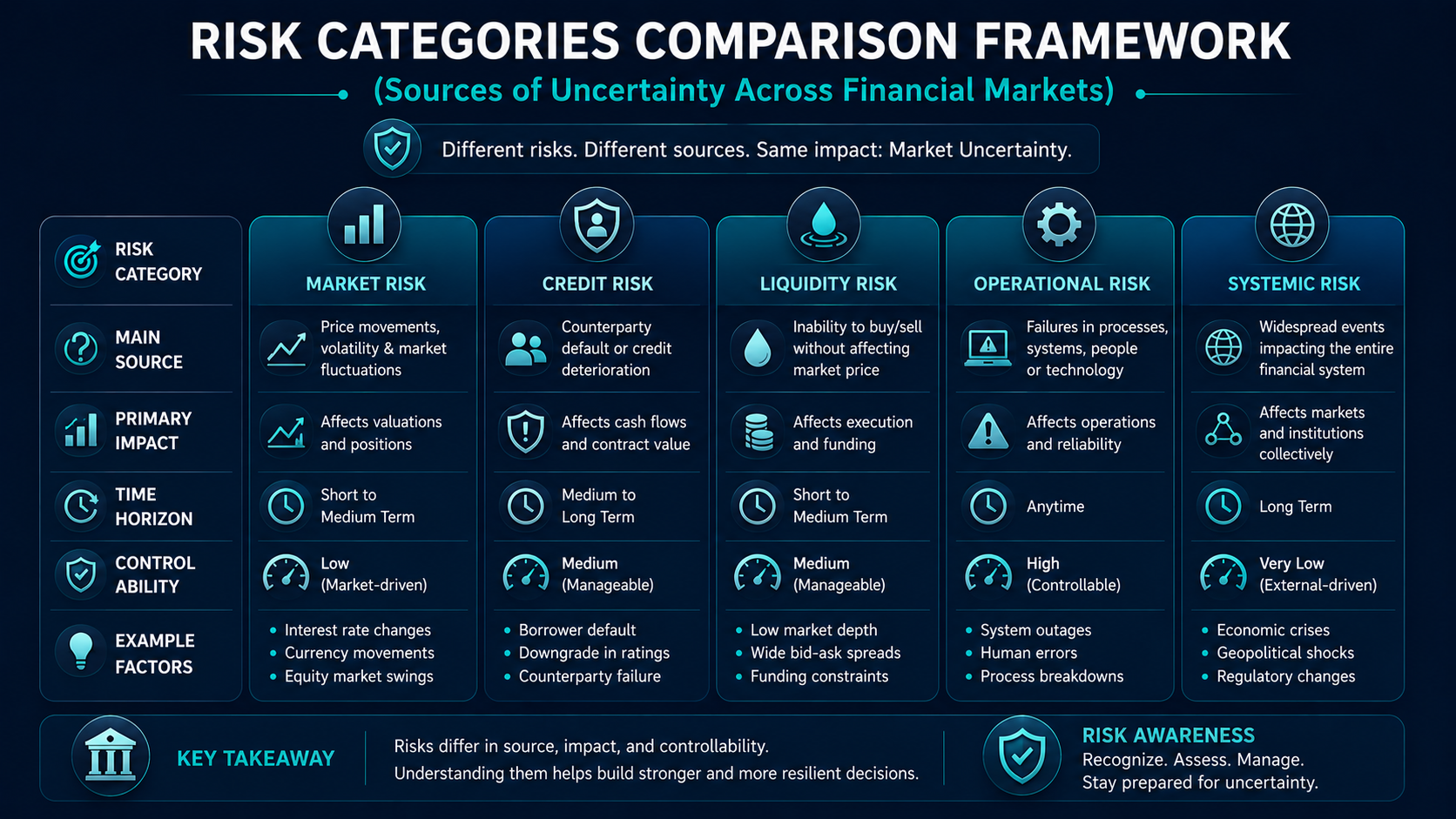
One of the most commonly discussed forms is market risk, which arises from changes in asset prices.
Another important category is liquidity risk. Liquidity relates to the ease with which market participants can transact within a market environment. Liquidity conditions can vary across assets and market situations.
Volatility risk refers to uncertainty associated with changing price fluctuations. Markets may experience periods of relatively stable movement as well as periods of heightened volatility.
Operational risk arises from processes, systems, infrastructure, or operational failures that may affect market activity.
Regulatory risk relates to uncertainty associated with policy changes, regulatory developments, or compliance-related adjustments.
Systemic risk refers to broader disruptions that may affect multiple participants or segments of the financial system simultaneously.
Together, these categories illustrate that risk extends beyond simple price movement and forms part of a much broader market framework.
Market Context (India-specific)
Indian financial markets provide practical examples of multiple risk categories operating simultaneously.
Participants in equity markets interact within environments influenced by domestic economic developments, corporate announcements, policy decisions, and global market conditions.
The derivatives segment introduces additional complexity because futures and options markets are influenced by factors such as volatility, liquidity, participant positioning, and broader market sentiment.
As participation in derivatives markets has increased, exchanges have continued emphasizing risk disclosures and investor awareness initiatives to improve understanding of market uncertainty.
The interconnected nature of India’s financial system demonstrates how different forms of risk can influence market conditions at the same time.
Behavioural Considerations
Many beginners initially associate risk only with adverse price movement. While price fluctuations represent one aspect of risk, the broader concept encompasses multiple dimensions of uncertainty.
Another common misconception is that risk remains constant across all market environments. In reality, different forms of uncertainty may become more or less significant depending on changing market conditions.
A conceptual understanding of risk categories can help learners appreciate the complexity of financial markets and reduce oversimplified interpretations of market behaviour.
Risk Management as a Market Stability Framework
Structural Characteristics
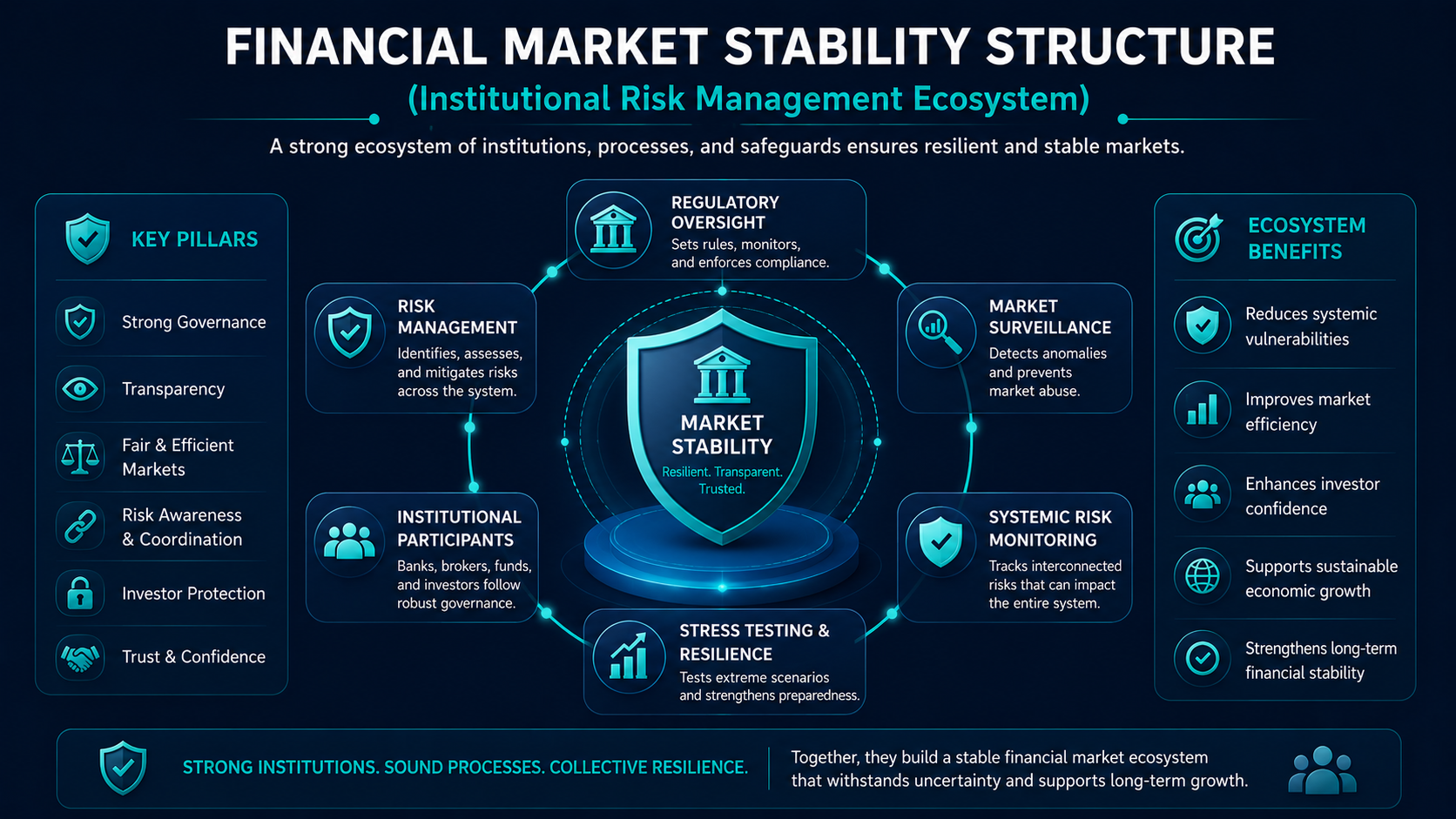
Risk management is often discussed as an individual concept, but it also operates at the institutional and market-wide level. Modern financial markets depend on a network of systems and organizations that work together to support orderly market functioning.
A useful way to understand this is by looking at the different layers involved in market operations.
| Market Layer | Primary Function |
|---|---|
| Regulator | Regulatory oversight and market integrity |
| Exchanges | Market operations and trading infrastructure |
| Clearing Corporations | Settlement and counterparty risk management |
| Depositories | Asset holding and record maintenance |
| Brokers and Intermediaries | Market access and operational processes |
| Market Participants | Buying, selling, and price discovery |
Each layer contributes to the broader stability of the financial system.
Clearing corporations, for example, play an important role in reducing settlement-related risks. Exchanges maintain surveillance systems designed to monitor unusual activity. Regulators establish disclosure requirements and market rules intended to promote transparency and fairness.
These systems do not remove uncertainty from financial markets. Instead, they provide frameworks designed to manage operational and systemic challenges that may arise within market ecosystems.
Market Context (India-specific)
India’s capital market infrastructure includes institutions that collectively contribute to market functioning.
The NSE and BSE facilitate trading activity across multiple market segments. Clearing corporations support settlement processes, while depositories maintain ownership records for securities held in dematerialized form.
SEBI oversees regulatory frameworks intended to support investor protection, transparency, and market integrity.
As retail participation has expanded, awareness regarding market infrastructure has become increasingly important. Many new participants focus primarily on price movement while remaining unfamiliar with the systems operating behind the scenes.
Understanding these institutional structures helps learners appreciate that modern financial markets involve significantly more than visible market activity.
Behavioural Considerations
A common misconception among beginners is that markets operate solely through buying and selling decisions.
In reality, financial markets function through a combination of participant activity, operational systems, regulatory oversight, and institutional infrastructure.
Recognizing these layers can reduce oversimplified interpretations of market behaviour and encourage a broader understanding of how financial markets operate.
It also highlights that risk management is not merely an individual concern. It is a concept embedded throughout the financial system.
Risk Management and Market Behaviour
Structural Characteristics
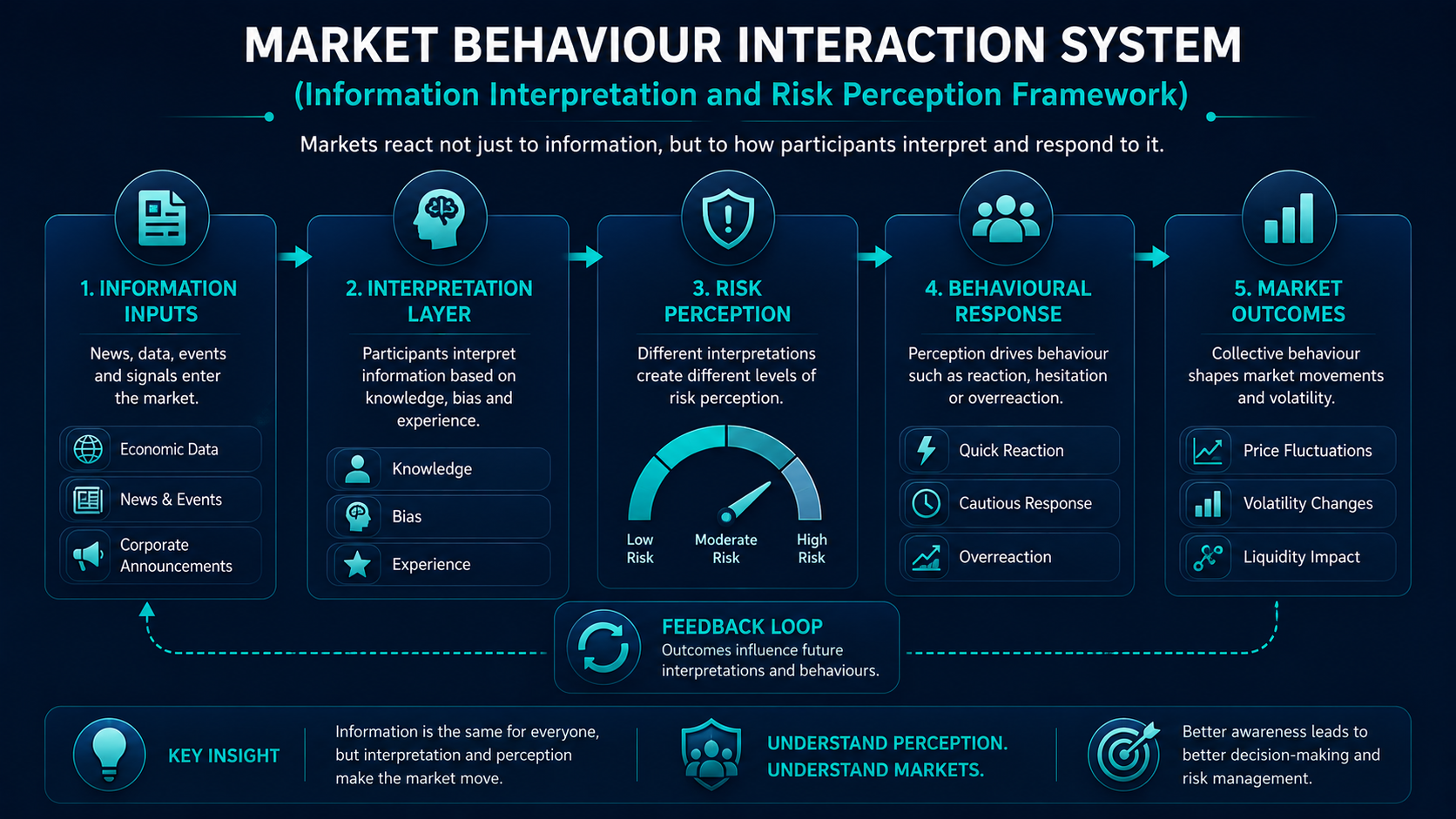
Risk management and market behaviour are closely connected because markets are influenced by both measurable factors and human decision-making.
Financial markets continuously process information. Economic data, corporate announcements, policy developments, geopolitical events, and participant expectations all contribute to changing market conditions.
As information changes, market participants adjust their views, resulting in fluctuations in price, liquidity, and volatility.
Because human behaviour is involved in this process, market reactions are not always uniform. Different participants may interpret the same information differently, contributing to diverse market outcomes.
This relationship between information, interpretation, and participant behaviour is one reason risk management remains relevant across all market environments.
Market Context (India-specific)
Indian financial markets have experienced various periods of heightened uncertainty associated with economic developments, policy announcements, global market events, and changing liquidity conditions.
These periods often demonstrate how market behaviour can change rapidly when new information enters the system.
The growing participation of retail investors and traders across equity and derivatives segments has added further diversity to market behaviour. Different participant groups may respond differently to the same market developments.
This variation reinforces the importance of understanding that market behaviour is influenced by a combination of structural, economic, and behavioural factors.
Behavioural Considerations
Behavioural finance provides valuable insights into how individuals perceive risk.
Several behavioural tendencies have been documented extensively in financial research.
Overconfidence Bias refers to the tendency to overestimate one’s understanding of market conditions.
Confirmation Bias involves giving greater attention to information that supports existing beliefs while overlooking contradictory information.
Recency Bias occurs when recent events receive greater importance than longer-term historical context.
Herd Behaviour describes situations in which participants are influenced by the actions of larger groups.
These behavioural tendencies do not affect only beginners. They have been observed across different participant categories and market environments.
Understanding these concepts helps learners appreciate that risk perception is influenced not only by market conditions but also by human interpretation of those conditions.
COMPARISON TABLE
| Concept | Focus | Source of Uncertainty | Common Misunderstanding |
|---|---|---|---|
| Risk Management | Understanding and monitoring uncertainty | Multiple market factors | Confused with prediction |
| Market Risk | Changes in asset prices | Market movement | Considered the only form of risk |
| Volatility | Magnitude of price fluctuations | Changing market activity | Treated as identical to risk |
| Liquidity Risk | Ease of market transactions | Availability of buyers and sellers | Often overlooked by beginners |
| Behavioural Risk | Human interpretation and decision-making | Cognitive biases and emotions | Viewed as a personal issue only |
| Systemic Risk | Broad financial system disruption | Interconnected market structures | Considered rare and irrelevant |
KEY TAKEAWAYS
- Risk management exists because uncertainty is a permanent feature of financial markets.
- Behavioural factors influence how market participants perceive and interpret risk.
- Risk extends beyond price movement and includes liquidity, operational, regulatory, and systemic considerations.
- Risk management frameworks operate at both individual and institutional levels.
- Understanding risk management improves awareness of uncertainty but does not determine market outcomes.
COMMON BEGINNER MISTAKES
- Assuming risk management is relevant only after participating in markets.
- Treating risk solely as adverse price movement.
- Confusing confidence with certainty.
- Believing market knowledge can eliminate uncertainty.
- Ignoring behavioural influences on market interpretation.
- Viewing risk management as a prediction tool rather than an awareness framework.
LIMITATIONS
Risk management is an important concept within financial markets, but it has limitations that learners should understand.
First, risk management cannot remove uncertainty from market systems. Financial markets remain influenced by changing information, economic developments, participant behaviour, and external events.
Second, risk management cannot guarantee specific outcomes. Even highly sophisticated institutions operate within environments characterized by uncertainty and incomplete information.
Third, risk management cannot fully eliminate behavioural influences. Human interpretation, judgment, and decision-making continue to affect how information is processed.
Fourth, risk management frameworks may evolve as markets evolve. New technologies, products, regulations, and market structures can introduce new forms of uncertainty.
A common professional-practice observation is that experienced institutions typically view risk management as an ongoing process rather than a final solution. This perspective reflects the reality that uncertainty remains a permanent characteristic of financial markets.
RISK AWARENESS
Risk awareness plays an important role in financial literacy because it encourages a more balanced understanding of market participation.
In India, the Securities and Exchange Board of India (SEBI) regularly emphasizes investor awareness, disclosure standards, and educational initiatives intended to improve understanding of financial market risks.
The National Stock Exchange and Bombay Stock Exchange also provide investor education resources, market disclosures, and awareness materials designed to help participants better understand market environments.
Risk awareness is particularly relevant in derivatives markets, where futures and options activity has grown substantially in recent years. Exchanges routinely publish risk disclosures because derivatives involve additional layers of complexity related to volatility, pricing, and market behaviour.
At the broader economic level, the Reserve Bank of India (RBI) monitors financial stability through periodic assessments of economic and financial conditions.
Factors such as:
- Inflation
- Interest rates
- Liquidity conditions
- Economic growth trends
- Global financial developments
can influence market environments and contribute to changing levels of uncertainty.
For this reason, risk awareness should be viewed as an ongoing component of financial literacy rather than a one-time concept.
Uncertainty remains present across all market environments regardless of prevailing sentiment or market direction.
WHAT THIS DOES NOT DO
Understanding risk management does not create certainty within financial markets.
It does not predict future market behaviour.
It does not eliminate market uncertainty.
It does not replace broader financial literacy.
It does not guarantee any specific market outcome.
It does not provide a mechanism for avoiding all forms of risk.
Most importantly, understanding risk management is not the same as achieving a particular result.
Understanding risk management improves awareness of uncertainty; it does not remove uncertainty itself.
Understanding ≠ Outcome
Financial markets remain influenced by numerous variables that cannot be fully known in advance. As a result, conceptual understanding and market outcomes should always be viewed as separate matters.
BEGINNER LEARNING PATH
Step 1: Understand Market Participants
Learn how retail participants, institutions, market makers, exchanges, and regulators interact within financial markets.
Step 2: Understand Price Discovery
Study how prices change as participants react to information, expectations, and market conditions.
Step 3: Learn About Market Risk
Develop an understanding of the different forms of uncertainty that exist within financial markets.
Step 4: Explore Behavioural Finance
Study how human decision-making, cognitive biases, and behavioural tendencies influence market interpretation.
Step 5: Understand Market Infrastructure and Regulation
Learn how exchanges, clearing corporations, depositories, and regulators contribute to market functioning.
FAQ SECTION
What is risk management in trading?
Risk management in trading refers to the process of identifying, assessing, monitoring, and understanding exposure to uncertainty within financial market activities.
Why does SEBI emphasize risk awareness?
SEBI promotes investor awareness because financial markets involve uncertainty. Improved awareness helps participants better understand market risks and disclosures.
Is risk management only relevant in derivatives markets?
No. Risk management is relevant across all financial market segments, including equities, bonds, commodities, currencies, and derivatives.
What is the difference between risk and volatility?
Risk is a broader concept that includes multiple forms of uncertainty. Volatility refers specifically to changes in price fluctuations and is only one component of overall risk.
Can market knowledge eliminate risk?
No. Market knowledge may improve understanding, but uncertainty remains a permanent feature of financial markets.
Why do institutions maintain risk frameworks?
Institutions maintain risk frameworks to monitor uncertainty, support operational stability, and manage exposure to changing market conditions.
AUTHOR SECTION
Vicky Mehta
Vicky Mehta is a stock market trainer with over 20+ years in financial markets and the founder of Succinct Learning Platforms Pvt. Ltd.
He holds an MBA in Financial Markets in collaboration with NSE Academy and is an NSE Certified Market Professional.
His work focuses on structured financial education, risk management frameworks, and disciplined market understanding.
SOURCES
- SEBI – Investor Awareness and Investor Protection Educational Material
- National Stock Exchange of India – Investor Education Resources, Market Activity Reports, and Derivatives Participation Data
- Bombay Stock Exchange – Investor Education and Market Information Resources
- Reserve Bank of India – Financial Stability Reports and Financial Sector Publications
- Academic literature on behavioural finance, market structure, and risk management
DISCLAIMER
This article is intended solely for educational and informational purposes.
The content is designed to improve financial literacy and explain financial market concepts. It does not constitute investment advice, trading advice, portfolio recommendations, research recommendations, or solicitation of any financial activity.
Financial markets involve uncertainty and risk. Readers seeking guidance regarding specific financial decisions should consult a suitably qualified professional, including a SEBI-registered investment adviser where appropriate.
Nothing in this article should be interpreted as a prediction, recommendation, or assurance regarding future market behaviour or financial outcomes.
other related topic
[Why Trading Still Feels Confusing Even After Learning]
I’ve started sharing structured trading insights here.
If you’re still trying to understand markets properly, this will help
[trading seekho whatsapp channel]