

Published: June 2026
Last Updated: June 2026
INTRODUCTION
The Indian stock market has witnessed a significant increase in retail participation over the last decade. Growing access to market information, educational content, financial news platforms, and online learning resources has enabled more individuals to develop market knowledge. At the same time, participation across cash market segments on the NSE and BSE, as well as awareness of derivative products, has expanded among retail participants.
Despite this increase in information availability, many learners continue to report confusion regarding market behaviour. This observation raises an important educational question: why does confusion often persist even after acquiring substantial market knowledge?
From an investor education perspective, this topic is important because knowledge and clarity are not identical concepts. Regulatory bodies such as the Securities and Exchange Board of India emphasize investor awareness and informed participation, yet markets remain environments characterized by uncertainty, multiple variables, and constantly changing conditions.
The purpose of this article is educational. It explains why market knowledge alone may not eliminate confusion, how market complexity influences understanding, and what conceptual limitations learners should recognize when studying financial markets.
WHY THIS TOPIC MATTERS FOR LEARNERS
Many beginners assume that confusion exists primarily because they do not possess enough information. As a result, they often seek additional books, videos, indicators, expert opinions, economic reports, or market commentary.
However, confusion frequently remains even after information levels increase.
Understanding this phenomenon is important because learners may incorrectly interpret confusion as evidence of inadequate effort. In reality, confusion can also emerge from the structure of financial markets themselves.
A common real-world observation is that two highly informed market participants can examine the same NSE-listed stock, review identical information, and still arrive at different interpretations. This does not necessarily indicate that one participant lacks knowledge. It often reflects the existence of multiple valid perspectives operating within a complex market system.
Recognizing this distinction helps learners develop a more realistic understanding of how markets function and why certainty remains limited despite extensive information availability.
1. What Is Market Knowledge?
Market knowledge refers to an individual’s understanding of financial market concepts, instruments, participants, regulations, economic influences, and market mechanisms. It includes awareness of how exchanges, companies, institutions, and investors interact within the broader financial ecosystem.
2. What Is Market Confusion?
Market confusion refers to uncertainty or difficulty in interpreting market behaviour despite the availability of information. It often arises when multiple explanations, conflicting signals, changing conditions, or incomplete information exist simultaneously within the market environment.
EXPLANATION
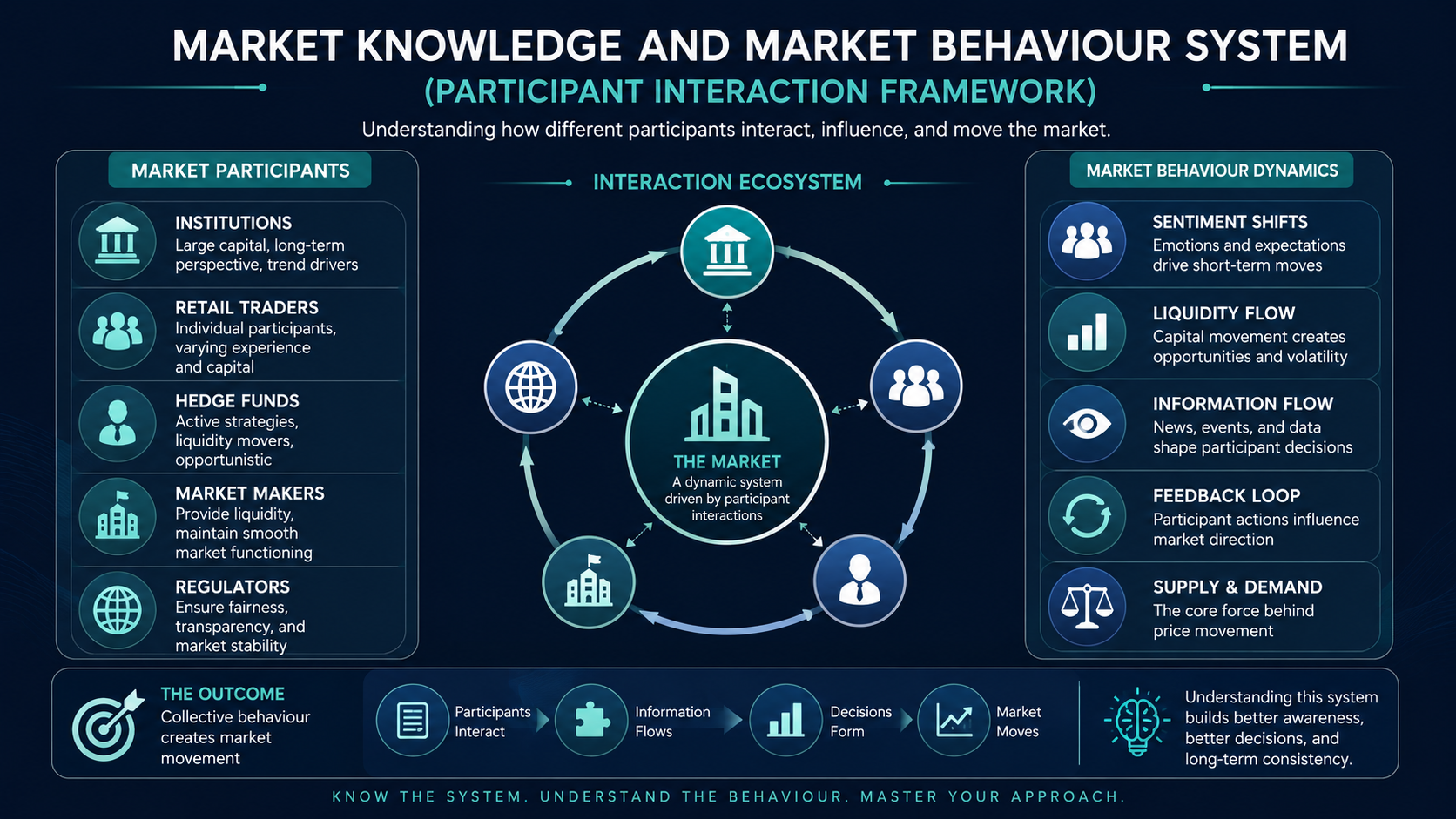
Financial markets operate as complex adaptive systems where millions of participants continuously interact through buying, selling, hedging, investing, speculating, and reallocating capital. These interactions create dynamic outcomes that cannot be fully understood through information alone.
Different participants enter the market with different objectives. Institutional investors, retail participants, mutual funds, foreign investors, hedge funds, market makers, and derivative traders often respond differently to the same event.
As information spreads across the market, participants interpret that information through their own assumptions, risk perceptions, time horizons, and behavioural biases. Consequently, identical information can generate diverse market responses.
Research in behavioural finance frequently suggests that information processing varies significantly across market participants, contributing to differences in interpretation even when factual information remains unchanged.
Therefore, market knowledge increases awareness of market components, but it does not eliminate the inherent complexity generated by participant interaction and uncertainty.
INFORMATION EXPANSION DOES NOT REMOVE COMPLEXITY
Structural Characteristics
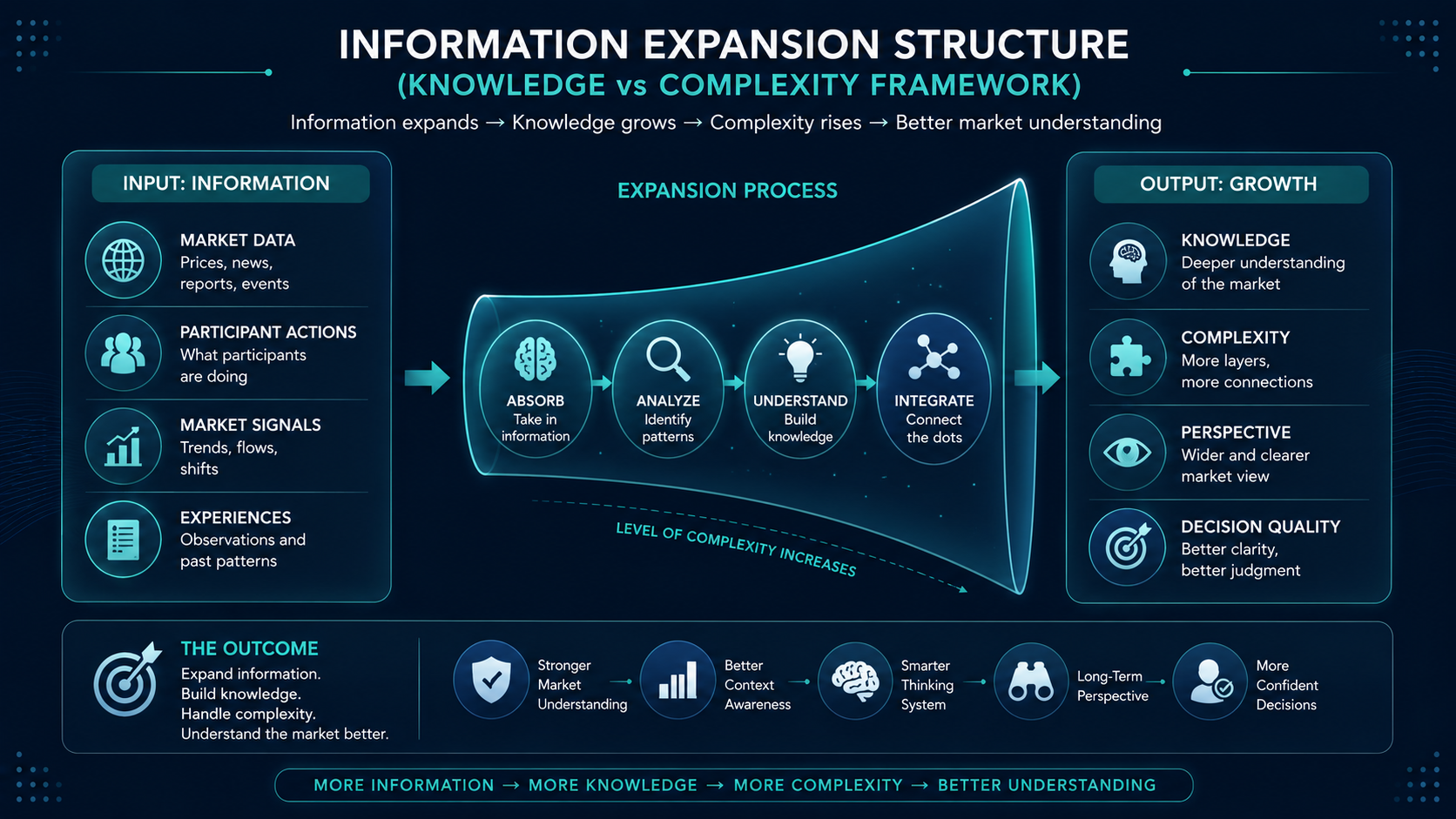
Financial markets continuously generate new information. Economic data, corporate announcements, policy developments, global events, sector-specific changes, and participant activity create an expanding information environment.
As knowledge increases, learners often discover additional variables rather than fewer variables. Understanding one concept frequently reveals several related concepts that also influence market behaviour.
This creates a situation where learning expands awareness while simultaneously exposing additional layers of complexity.
Market Context (India-specific)
Indian market participants regularly monitor information originating from NSE-listed companies, BSE disclosures, government policy announcements, regulatory developments, and international economic events.
Additionally, derivative market activity has become more visible among retail participants. Futures and options markets often introduce another layer of interpretation because participants may analyze market conditions through different frameworks.
As information sources increase, interpretation challenges may also increase.
Behavioural Considerations
Many learners assume that more information automatically produces greater certainty. This expectation can create frustration when conflicting information emerges.
When individuals encounter multiple explanations for the same market movement, confusion may increase rather than decrease. The issue often lies not in the absence of information but in the presence of numerous competing interpretations.
DIFFERENT PARTICIPANTS CREATE DIFFERENT MARKET MEANINGS
Structural Characteristics
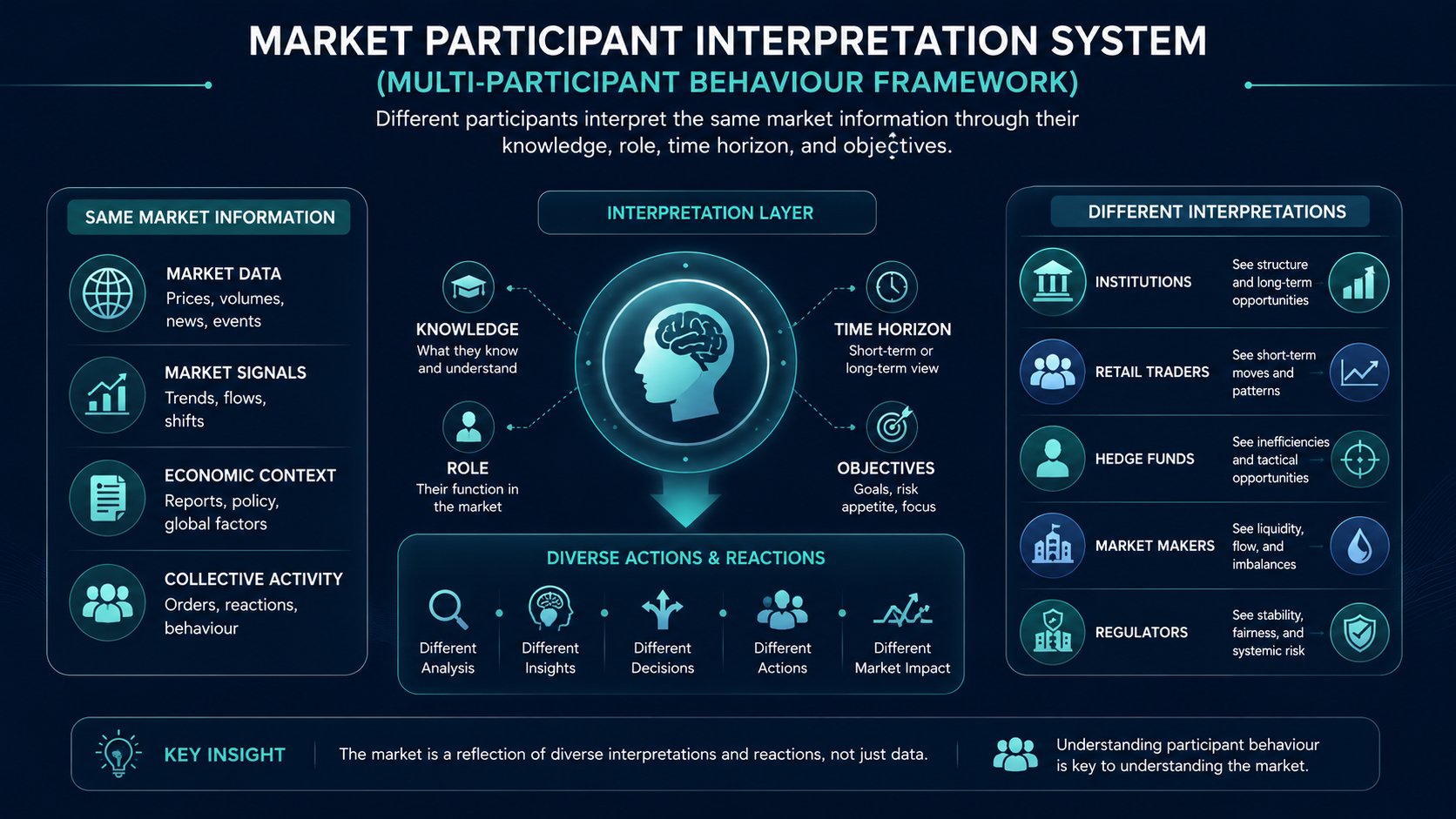
Markets contain participants with diverse objectives and constraints.
For example:
- Long-term investors may focus on business fundamentals.
- Institutions may focus on portfolio allocation.
- Derivative participants may focus on risk transfer.
- Market makers may focus on liquidity provision.
- Retail participants may focus on price behaviour.
Because these objectives differ, identical information can produce different responses.
Market Context (India-specific)
The Indian market ecosystem includes domestic institutions, retail investors, proprietary trading firms, mutual funds, insurance companies, and foreign portfolio investors.
Each participant group may evaluate the same event differently. A policy announcement, earnings release, or economic indicator can generate multiple interpretations simultaneously.
This diversity contributes to market complexity and explains why consensus is often limited.
Behavioural Considerations
Beginners often expect a single correct explanation for market movement.
However, markets frequently contain overlapping narratives. Multiple participants may act rationally according to their own objectives even when their conclusions differ.
Understanding this characteristic helps explain why confusion can persist despite increased knowledge.
KNOWLEDGE DOES NOT ELIMINATE UNCERTAINTY
Structural Characteristics
Uncertainty is a permanent feature of financial markets.
Future economic conditions, corporate performance, geopolitical developments, policy decisions, liquidity conditions, and participant behaviour cannot be fully known in advance.
Knowledge improves understanding of these variables but cannot remove uncertainty from the system.
Market Context (India-specific)
Indian markets are influenced by domestic and global factors simultaneously.
Events involving inflation, interest rates, currency movements, fiscal policy, global capital flows, and international developments can affect market sentiment and valuation perspectives.
Even extensive knowledge of these variables cannot guarantee complete clarity because future developments remain unknown.
Behavioural Considerations
A common misconception is that uncertainty exists only because individuals have not studied enough.
In reality, uncertainty often exists because markets themselves are uncertain.
Recognizing this distinction is important. It helps learners understand that confusion is not always a knowledge problem. Sometimes it reflects the nature of the environment being studied.
INFORMATION AND UNDERSTANDING ARE NOT THE SAME THING
Structural Characteristics
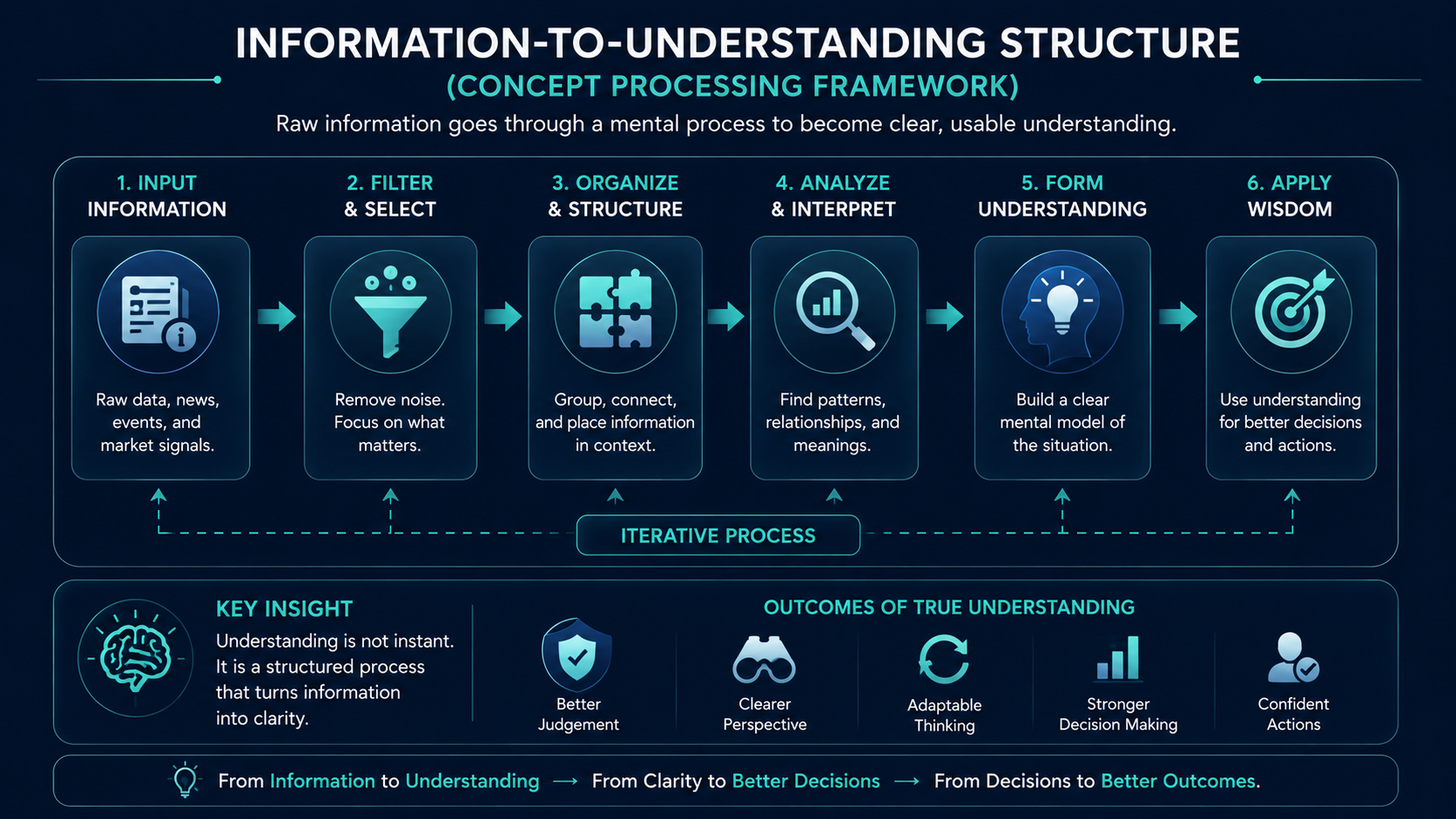
Information represents raw inputs. Understanding represents the ability to place those inputs within a broader conceptual framework.
A learner may possess extensive information while still struggling to understand how various factors interact.
This distinction becomes important because market systems involve relationships between economic variables, participant behaviour, regulatory structures, liquidity conditions, and expectations.
Market Context (India-specific)
Retail participation in India has expanded rapidly due to digital platforms, educational content, and financial awareness initiatives.
As a result, many individuals have access to large amounts of market information. However, information access alone does not necessarily create coherent understanding of market structure.
Educational institutions and investor awareness initiatives increasingly emphasize conceptual learning rather than information accumulation alone.
Behavioural Considerations
Information overload can create the illusion of progress while simultaneously increasing confusion.
When learners encounter numerous opinions, frameworks, and interpretations, they may struggle to organize information into a consistent understanding.
This challenge is behavioural as much as informational because the human mind naturally seeks certainty in environments that may not provide it.
COMPARISON TABLE
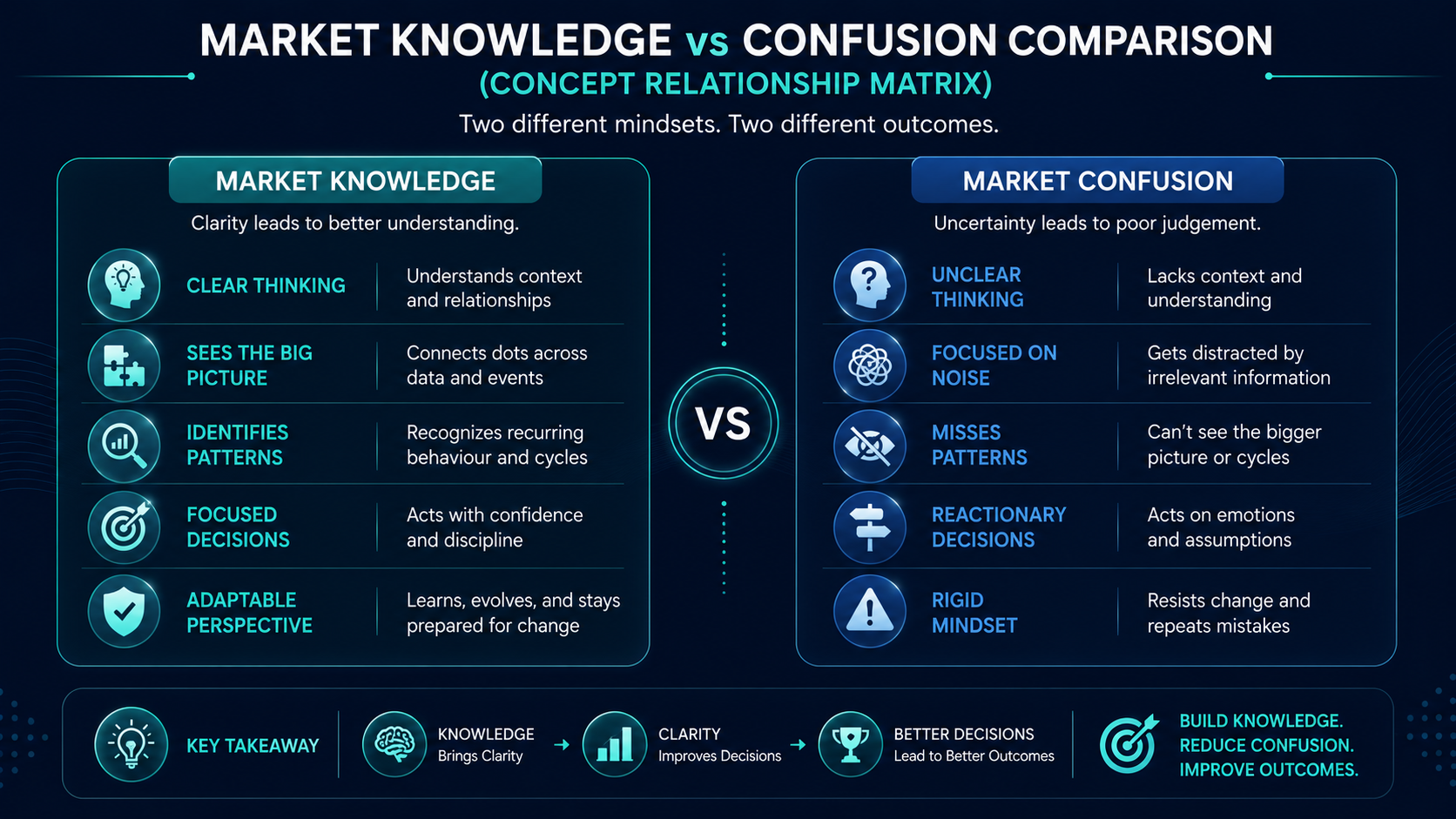
| Concept | Core Issue | Market Impact | Learning Challenge |
|---|---|---|---|
| Market Knowledge | Expands information exposure | Increases awareness of variables | Understanding relationships between concepts |
| Market Confusion | Multiple interpretations exist | Creates uncertainty in understanding | Distinguishing information from clarity |
| Participant Diversity | Different objectives and perspectives | Generates varied market responses | Accepting multiple viewpoints |
| Market Uncertainty | Future conditions remain unknown | Limits predictability | Recognizing structural limitations |
| Information Overload | Excessive data availability | Complicates interpretation | Organizing information meaningfully |
KEY TAKEAWAYS
- Market knowledge improves conceptual awareness but does not automatically eliminate confusion.
- Participant behaviour often creates multiple valid interpretations of the same information.
- Knowledge has limitations when uncertainty is a permanent market characteristic.
- Information overload can introduce additional risks of misunderstanding and misinterpretation.
- Understanding market structure does not remove the reality of uncertain outcomes.
COMMON BEGINNER MISTAKES
- Assuming confusion exists only because insufficient information has been collected.
- Expecting a single explanation for every market movement.
- Treating information accumulation as equivalent to understanding.
- Ignoring the role of participant diversity in shaping market behaviour.
- Believing uncertainty disappears as knowledge increases.
- Overestimating the ability of market information to provide complete clarity.
LIMITATIONS
Market knowledge cannot eliminate uncertainty, participant diversity, changing economic conditions, or evolving market narratives.
It cannot provide complete explanations for every market movement because markets operate through the interaction of numerous visible and invisible factors.
A professional-practice observation across financial institutions is that experienced market participants often continue to encounter uncertainty despite possessing substantial expertise. Experience may improve contextual understanding, but it does not remove the complexity of the environment itself.
Therefore, market knowledge should be viewed as a tool for understanding rather than a mechanism for eliminating confusion entirely.
RISK AWARENESS
Financial markets remain subject to economic, regulatory, behavioural, and global influences.
Regulatory oversight by the Securities and Exchange Board of India contributes to market integrity and investor protection, but regulation does not remove uncertainty from market outcomes.
Macroeconomic developments monitored by the Reserve Bank of India, including inflation trends, liquidity conditions, interest-rate environments, and financial stability considerations, can influence market behaviour in ways that are difficult to anticipate completely.
As a result, uncertainty remains an inherent characteristic of financial markets regardless of the amount of information available to participants.
WHAT THIS DOES NOT DO
Understanding market knowledge and its limitations does not create certainty regarding future market behaviour.
Understanding ≠ outcome.
Learning about market structure improves conceptual awareness, but it does not eliminate uncertainty, guarantee clarity, or create predictable market conditions.
Educational understanding should therefore be distinguished from expectations regarding future market behaviour.
BEGINNER LEARNING PATH
- Understand the basic structure of financial markets and their participants.
- Study how information flows through market systems.
- Learn the role of institutions, exchanges, regulators, and retail participants.
- Explore behavioural finance concepts related to perception and decision-making.
- Develop awareness of uncertainty as a permanent market characteristic.
FAQ SECTION
What is market knowledge?
Market knowledge refers to understanding how financial markets operate, including participants, instruments, regulations, and market mechanisms.
Why is market confusion often misunderstood?
Many people assume confusion results only from insufficient information. In reality, confusion can also arise from market complexity and multiple competing interpretations.
Does more information always create more clarity?
Not necessarily. Additional information may reveal new variables and relationships, which can increase complexity rather than reduce it.
Why can two informed participants disagree?
Participants often have different objectives, assumptions, time horizons, and analytical frameworks. These differences can lead to different conclusions from the same information.
Is uncertainty a sign of inadequate knowledge?
Not always. Uncertainty is a structural feature of financial markets and exists even among highly experienced participants.
Why is this concept important for retail participants?
It helps retail participants develop realistic expectations about what education can and cannot provide in a complex market environment.
AUTHOR
Vicky Mehta
Vicky Mehta is a stock market trainer with over 20+ years in financial markets and the founder of Succinct Learning Platforms Pvt. Ltd.
He holds an MBA in Financial Markets in collaboration with NSE Academy and is an NSE Certified Market Professional.
His work focuses on structured financial education, risk management frameworks, and disciplined market understanding.
SOURCES
SEBI Investor Education and Awareness Initiatives
DISCLAIMER
This article is intended solely for educational and investor-awareness purposes.
The content does not constitute investment advice, trading advice, research recommendations, portfolio guidance, or solicitation to participate in any financial market activity.
Readers seeking advice related to investments, securities, or financial products should consult an appropriately qualified and SEBI-registered investment adviser or other authorized financial professional, where applicable.
Educational understanding of markets should not be interpreted as a basis for making financial decisions.
other related topic
[Why Learning About Trading Does Not Always Change Market Outcomes]
I’ve started sharing structured trading insights here.
If you’re still trying to understand markets properly, this will help
[trading seekho whatsapp channel]