

Published: June 2026
Last Updated: June 2026
INTRODUCTION
The availability of financial market education has expanded rapidly in India over the last decade. Learners today can access trading videos, market discussions, educational articles, webinars, podcasts, and social media content covering a wide range of topics related to stock markets and derivatives.
As participation in the National Stock Exchange (NSE) and Bombay Stock Exchange (BSE) continues to grow, retail participants are consuming more educational content than ever before. The Securities and Exchange Board of India (SEBI) has consistently emphasized investor awareness, financial literacy, and informed decision-making within financial markets.
Many individuals searching for a Stock Market Institute in Jalandhar begin their learning journey through free online resources before exploring structured educational programs. While access to information has become easier, many beginners eventually report confusion despite spending significant time consuming market-related content.
One of the lesser-discussed challenges in financial education is the hidden cost of learning from too many unrelated sources. Rather than developing a connected understanding of market structure, learners may accumulate fragmented concepts, conflicting interpretations, and disconnected terminology.
This article explores the educational and behavioural implications of learning trading from multiple sources. The objective is not to evaluate any particular educational method but to explain how information structure influences understanding within the Indian stock market environment.
WHY THIS TOPIC MATTERS FOR LEARNERS
The topic is important because beginner confusion is often misunderstood. Many learners assume confusion occurs because they lack information. In reality, confusion frequently develops when information is consumed without an organizing framework.
Learners attending Stock Market Classes in Jalandhar or exploring educational material through online platforms are commonly exposed to technical analysis concepts, market psychology discussions, derivatives awareness content, and macroeconomic commentary. Each topic may be useful independently, but understanding how they connect requires context.
A commonly observed real-world pattern is that beginners may watch hundreds of hours of educational content and still struggle to explain how liquidity, volatility, participant behaviour, and market structure interact within the same system.
Understanding the hidden cost of fragmented learning helps improve financial literacy and reduces misconceptions about how market education functions.
1. What Is Fragmented Learning?
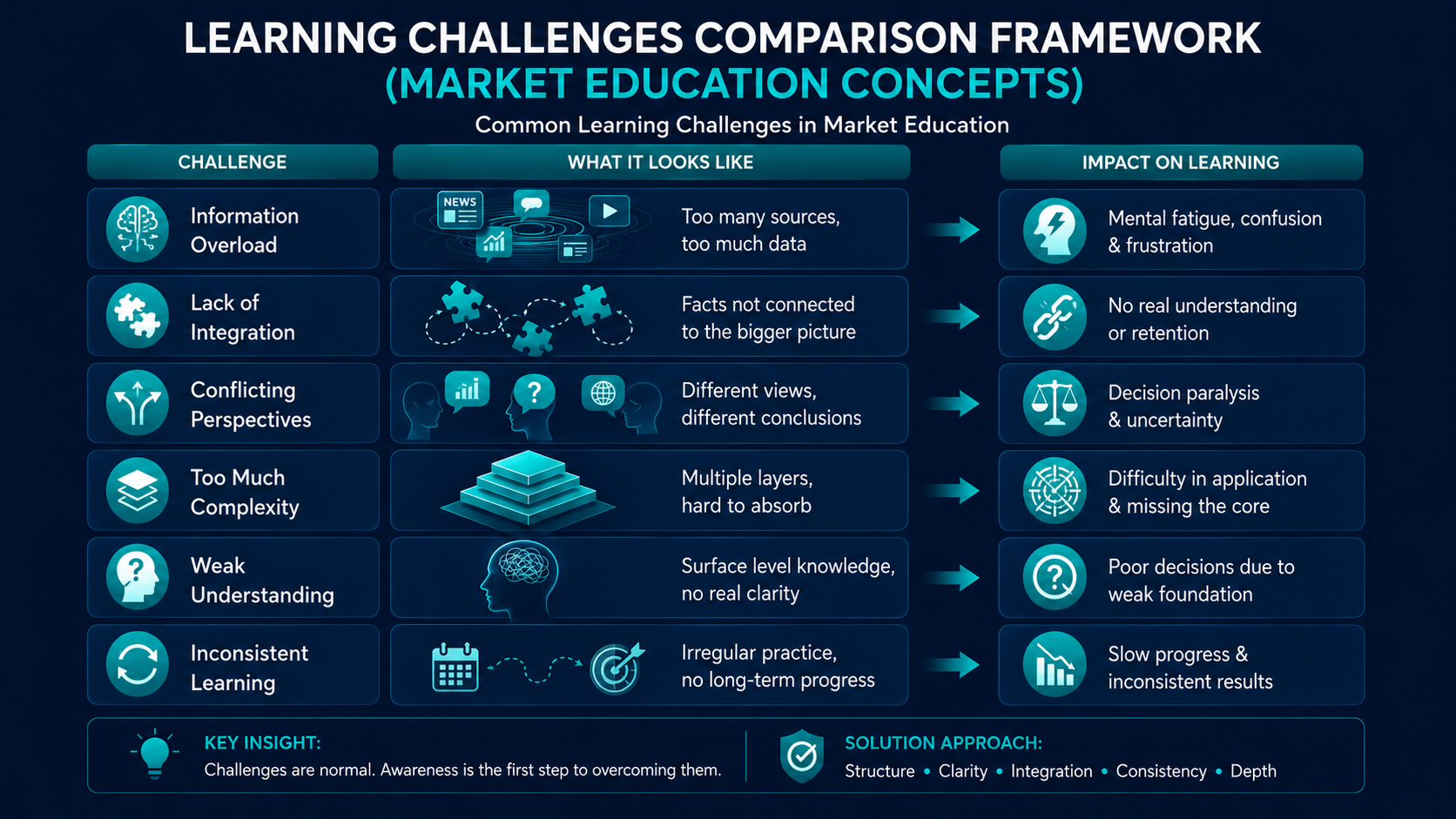
Fragmented learning refers to the process of acquiring information from multiple independent sources without a consistent framework connecting those concepts. Within financial education, fragmented learning can make it difficult to understand relationships between different market variables.
2. What Is Information Saturation?
Information saturation refers to a condition in which the volume of educational material exceeds an individual’s ability to effectively process, organize, and contextualize information. Increased exposure may therefore create complexity rather than clarity.
EXPLANATION
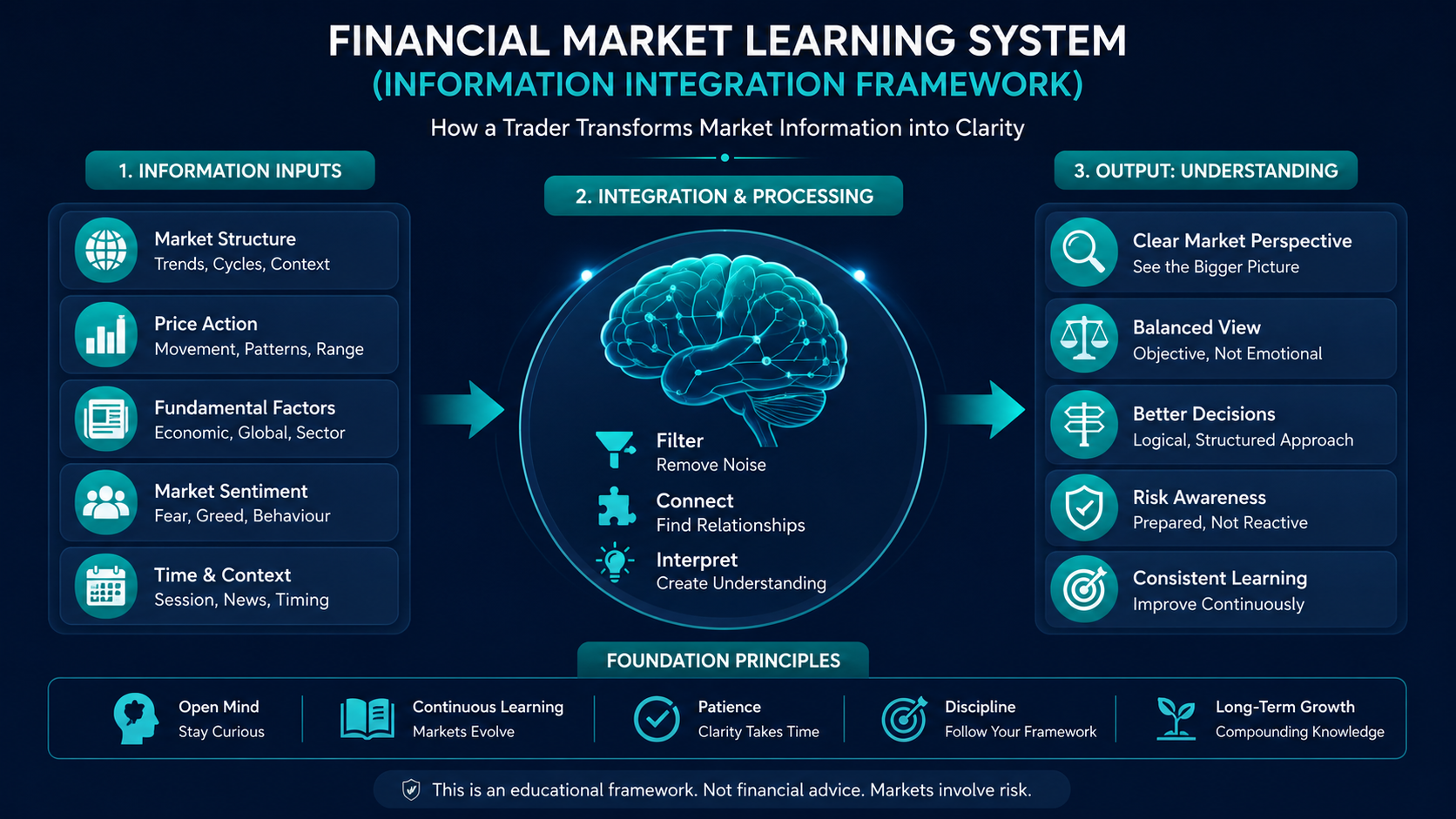
Financial markets are complex systems influenced by institutional participation, retail participation, liquidity conditions, derivatives activity, economic developments, regulatory frameworks, and behavioural responses. Understanding these systems requires more than exposure to isolated concepts.
Educational content is often designed around specific topics such as technical analysis concepts, behavioural finance, derivatives awareness, or market psychology. While individual explanations may be accurate, learners frequently encounter difficulties when attempting to combine multiple frameworks obtained from unrelated sources.
Within India, the rapid growth of retail participation has significantly increased the volume of financial content available across digital platforms. This development has improved access to education but has also increased the possibility of conceptual fragmentation.
Research within cognitive and educational psychology suggests that understanding depends not only on information quantity but also on the organization of knowledge structures and conceptual relationships.
As a result, the hidden cost of learning from too many sources is often reflected through reduced conceptual clarity rather than a shortage of information.
CORE EDUCATIONAL SECTIONS
Information Without Context
Structural Characteristics
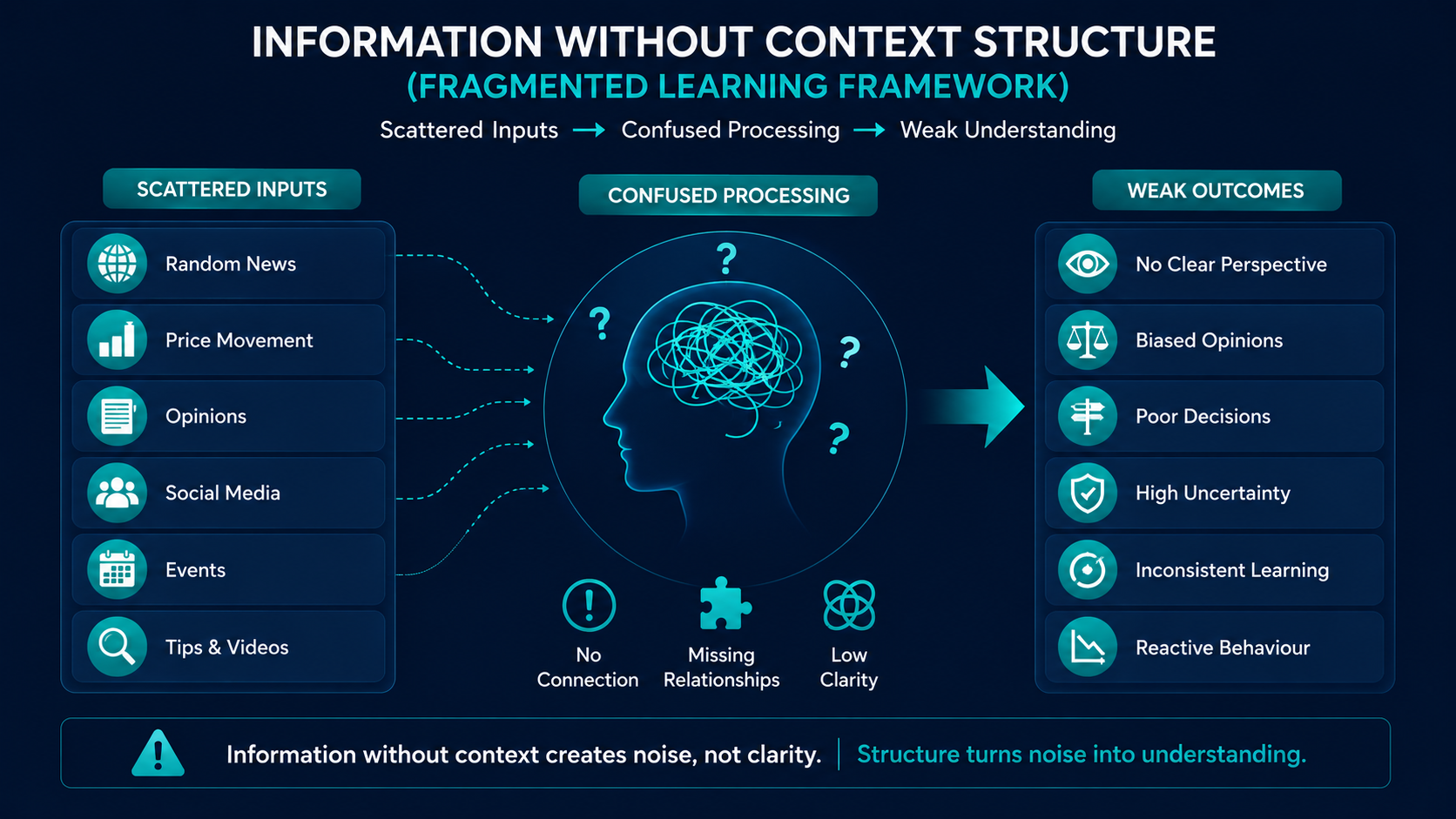
Most educational content focuses on specific subjects rather than complete market systems. One source may discuss chart interpretation, another may focus on behavioural finance, while a third may explain derivatives awareness or liquidity and volatility.
Each explanation may be valid within its intended context. However, when these concepts are consumed independently, learners often struggle to understand how they interact within the broader market ecosystem.
The challenge therefore does not arise from incorrect information but from the absence of contextual relationships between concepts.
Market Context (India-specific)
The growth of retail participation in NSE and BSE-listed securities has expanded demand for stock market education across India. Educational institutions, online platforms, and financial communities now provide extensive learning resources covering market structure, technical analysis concepts, and derivatives markets.
Many learners evaluating a Share Market Institute in Jalandhar or searching for educational content online encounter multiple frameworks explaining market behaviour. Without a structured sequence, these frameworks may appear disconnected.
As information availability increases, understanding the relationship between concepts becomes increasingly important.
Behavioural Considerations
Individuals naturally seek simplified explanations when learning complex subjects. When exposed to numerous independent explanations, learners may unintentionally combine concepts that serve different purposes.
This often creates confusion regarding which concepts explain market structure, which describe behavioural patterns, and which discuss specific market conditions.
A structured Trading Academy in Jalandhar typically attempts to organize concepts into a coherent educational pathway rather than presenting isolated pieces of information.
Conflicting Educational Frameworks
Structural Characteristics
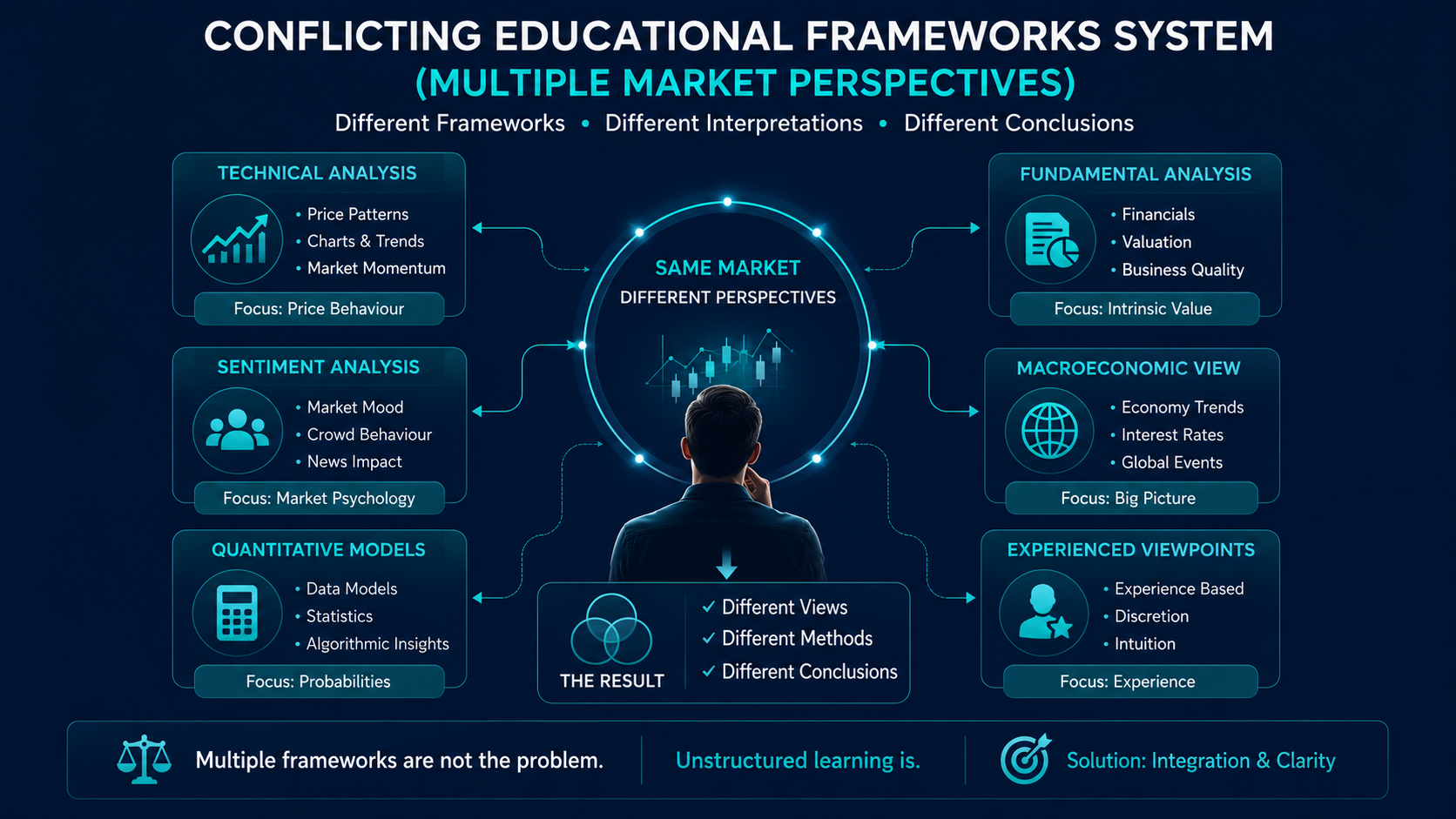
Financial markets can be analyzed through multiple frameworks. Some educational sources emphasize market structure, while others focus on behavioural finance, institutional participation, liquidity conditions, economic developments, or derivatives positioning.
These frameworks often operate simultaneously rather than competitively. However, learners may interpret differences as contradictions when contextual understanding is limited.
The presence of multiple perspectives reflects market complexity rather than educational inconsistency.
Market Context (India-specific)
Within Indian market education, discussions frequently include NSE derivatives participation, RBI policy decisions, sectoral developments, institutional fund flows, and retail participation trends.
As beginners compare educational content from different providers, including a Best Trading Institute in Jalandhar, they may encounter varying interpretations of the same market event.
Different explanations may focus on different variables while still describing the same market environment.
Behavioural Considerations
Many beginners expect a single explanation for market activity. When multiple perspectives exist, uncertainty may be interpreted as inconsistency.
This expectation can increase confusion because financial markets rarely operate through one-dimensional causes.
Behavioural research frequently highlights the tendency of learners to seek certainty even within uncertain systems.
Cognitive Overload and Learning Fatigue
Structural Characteristics
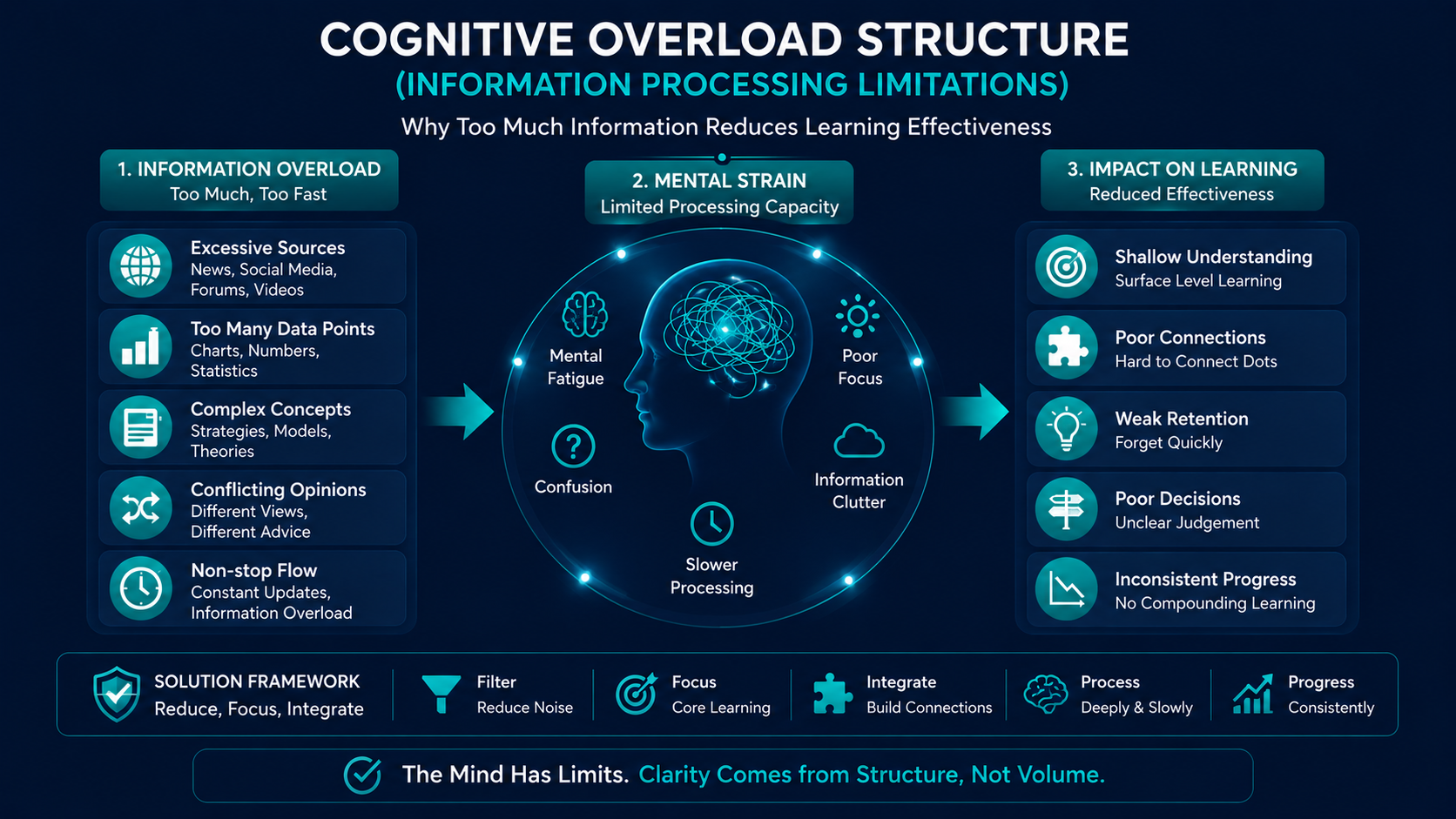
Human cognitive capacity has practical limitations. Learning efficiency depends not only on information quality but also on the ability to process, organize, and integrate information effectively.
When learners continuously consume content without connecting concepts, information accumulation may exceed processing capacity. This often results in cognitive overload.
Financial market education involves numerous interconnected subjects, making conceptual organization especially important.
Market Context (India-specific)
The Indian financial education ecosystem has expanded rapidly through educational channels, webinars, online communities, and digital learning platforms.
Many learners searching for Stock Market Classes in Jalandhar simultaneously consume content from several additional sources. While this increases exposure to information, it may also increase the likelihood of information saturation.
As content availability expands, the challenge shifts from finding information to organizing information.
Behavioural Considerations
Cognitive overload may reduce the ability to distinguish between foundational concepts and secondary details.
Learners experiencing learning fatigue often report that markets appear increasingly complicated despite consuming more content.
This observation reflects the challenges of information organization rather than a lack of educational material.
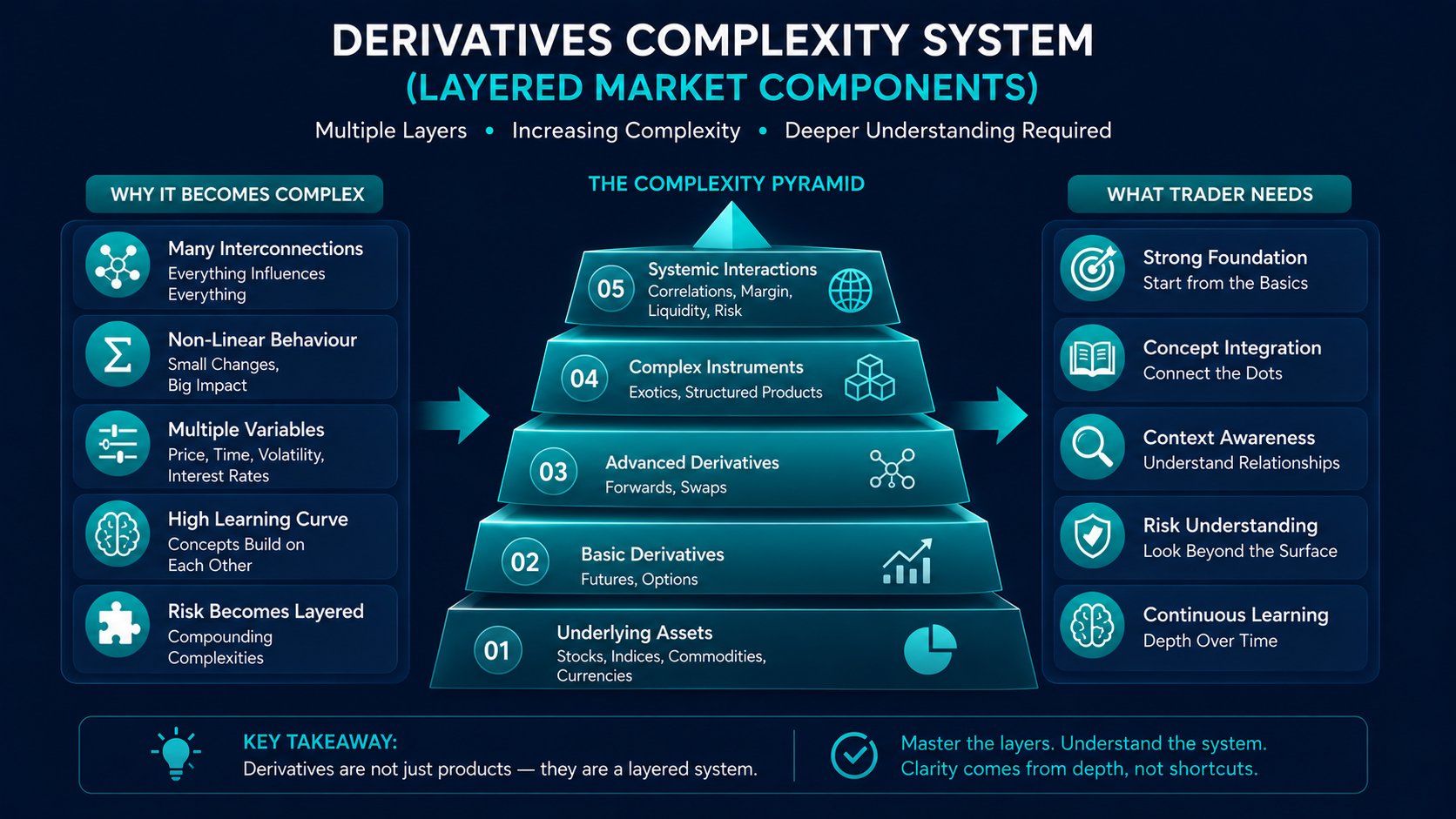
Derivatives Complexity and Layered Information
Structural Characteristics
Derivatives markets involve multiple interacting variables including volatility, liquidity, pricing behaviour, participant positioning, and time-related influences.
Educational content frequently isolates individual derivatives concepts for simplicity. However, understanding one variable independently does not necessarily explain the broader derivatives ecosystem.
This layered complexity often contributes to fragmented understanding when concepts are learned from unrelated sources.
Market Context (India-specific)
India maintains one of the world’s largest derivatives markets, with substantial activity occurring through NSE-listed derivative products. Retail participation in derivatives has increased significantly over recent years.
SEBI has repeatedly emphasized awareness regarding derivatives-related complexity and associated risks. Educational discussions therefore require contextual understanding rather than isolated concept exposure.
Learners evaluating a Stock Market Institute in Jalandhar often encounter derivatives-related content before fully understanding broader market structure relationships.
Behavioural Considerations
Complex subjects frequently appear straightforward when individual concepts are explained separately. However, as learners encounter additional layers of information, earlier assumptions may appear incomplete.
This experience is common in financial education and reflects the interconnected nature of market systems rather than deficiencies in learning itself.
COMPARISON TABLE
| Concept | Core Issue | Market Impact | Learning Challenge |
|---|---|---|---|
| Fragmented Learning | Concepts learned independently without a unified framework | Difficulty understanding market relationships | Connecting separate concepts into a complete market view |
| Information Saturation | Excessive educational content consumption | Reduced conceptual clarity | Organizing and prioritizing information |
| Conflicting Frameworks | Multiple explanations of market behaviour | Perceived inconsistency in interpretation | Understanding context behind different viewpoints |
| Derivatives Complexity | Multiple interacting market variables | Increased conceptual difficulty | Understanding layered relationships within financial markets |
KEY TAKEAWAYS
- Market education requires contextual understanding rather than exposure to large quantities of information.
- Behavioural expectations often influence how learners interpret financial content.
- Individual educational frameworks have limitations when viewed in isolation.
- Information overload can create conceptual and cognitive challenges in market learning.
- Financial market understanding should not be confused with certainty regarding market behaviour.
COMMON BEGINNER MISTAKES
- Consuming educational content from too many unrelated sources simultaneously.
- Assuming that more information automatically creates deeper understanding.
- Treating all market explanations as mutually exclusive rather than contextual.
- Confusing familiarity with terminology for conceptual understanding.
- Ignoring the interconnected nature of market structure, liquidity, and participant behaviour.
- Underestimating the complexity associated with derivatives-related educational content.
LIMITATIONS
Understanding the hidden cost of learning from multiple sources does not eliminate the complexity of financial markets. This concept helps explain educational and behavioural challenges, but it cannot fully describe every aspect of market activity.
Financial markets continue to evolve through changes in liquidity, regulation, participant behaviour, institutional activity, and macroeconomic conditions. These factors interact continuously and cannot be fully captured through any single educational framework.
A common professional-practice observation is that experienced market participants frequently revisit foundational concepts throughout their careers. This reflects the dynamic nature of markets rather than a deficiency of information.
RISK AWARENESS
The Securities and Exchange Board of India (SEBI) regularly promotes investor awareness, financial literacy, and responsible participation in financial markets. Educational material should therefore be viewed as a resource for conceptual understanding rather than a substitute for recognizing market uncertainty.
The Reserve Bank of India (RBI) monitors inflation trends, liquidity conditions, economic stability, and broader macroeconomic developments that may influence market environments. These factors can affect market behaviour in ways that are not always visible through isolated educational content.
Financial markets remain uncertain systems. Regardless of the quantity of information consumed, uncertainty continues to be a permanent characteristic of market participation.
WHAT THIS DOES NOT DO
This article does not provide trading advice, execution methods, market recommendations, or participation frameworks.
It does not identify opportunities, explain market timing, recommend securities, or suggest financial decisions.
Most importantly:
Understanding ≠ outcome
Educational understanding may improve conceptual clarity, but it should not be interpreted as certainty regarding future market conditions or participant experiences.
BEGINNER LEARNING PATH
- Understand the structure and purpose of Indian financial markets.
- Learn the role of NSE, BSE, SEBI, RBI, and different market participants.
- Explore how liquidity, volatility, and participant interaction influence market activity.
- Study the relationship between information, interpretation, and uncertainty.
- Develop awareness of how educational frameworks shape market understanding.
FAQ SECTION
What is the hidden cost of learning trading from too many sources?
The hidden cost refers to conceptual fragmentation, information saturation, and difficulty connecting market concepts into a coherent framework. More information does not automatically create better understanding.
Why do learners attending Stock Market Classes in Jalandhar still experience confusion?
Many learners consume information from multiple educational channels simultaneously. When concepts are learned without context, understanding market relationships can become difficult despite significant exposure to educational material.
Why is information overload common in stock market education?
Financial markets involve numerous subjects including market psychology, derivatives awareness, technical analysis concepts, liquidity and volatility, and macroeconomic developments. Exposure to all these topics simultaneously can create cognitive overload.
Can a Trading Academy in Jalandhar simplify financial markets completely?
No. Financial markets remain complex systems influenced by participant behaviour, liquidity conditions, economic developments, and regulatory environments. Education can explain concepts, but complexity remains inherent.
Why do learners compare different Stock Market Institutes in Jalandhar?
Educational institutions often differ in curriculum structure, conceptual depth, educational philosophy, and learning methodology. These differences can influence how learners understand market concepts.
Why are derivatives often difficult for beginners to understand?
Derivatives involve multiple interacting variables such as volatility, liquidity, participant positioning, pricing behaviour, and time-related influences, making them conceptually complex.
AUTHOR SECTION
Vicky Mehta
Vicky Mehta is a stock market educator with more than 20+ years in financial market education and learner development. He holds an MBA in Financial Markets associated with NSE Academy and is an NSE-certified market professional.
His educational work focuses on structured education, financial literacy, risk frameworks, behavioural awareness, market psychology, and disciplined learning approaches. Through his Share Market Institute in Jalandhar, he emphasizes conceptual understanding, market structure awareness, and long-term educational development.
Learners searching for a Stock Market Institute in Jalandhar, Best Trading Institute in Jalandhar, Stock Market Classes in Jalandhar, or a Trading Academy in Jalandhar often engage with educational content that explains how markets function rather than attempting to simplify market complexity.
His educational philosophy focuses on discipline, conceptual clarity, and structured financial learning within the Indian market environment.
SOURCES
- SEBI – Investor Awareness & Protection educational material
- NSE – Market activity reports and derivatives participation data
- RBI – Financial Stability Reports and macroeconomic publications
DISCLAIMER
This article is published strictly for educational and informational purposes only.
The content does not constitute investment advice, research recommendations, portfolio guidance, or market participation instructions. Nothing contained in this article should be interpreted as a recommendation to buy, sell, hold, or transact in any financial instrument.
Individuals seeking regulated financial guidance should consult an appropriate professional, including a SEBI-registered investment advisor where applicable.
other related topic
[ What Is Risk Management in Trading ]
I’ve started sharing structured trading insights here.
If you’re still trying to understand markets properly, this will help