

Published: March 2026
Last Updated: April 2026
INTRODUCTION
Options trading is widely discussed in Indian financial markets.
But it is rarely explained in a way beginners can clearly understand.
Most new participants enter the market with access:
- Trading platforms
- Market data
- Charting tools
Yet, despite this access, confusion remains.
Why?
Because access has increased.
Clarity has not.
Retail participation in derivatives—especially index options—has grown significantly in recent years. Data from National Stock Exchange of India shows that options trading forms a substantial portion of activity among retail participants.
However, the structural complexity of derivatives markets often remains underexplored at the beginner level.
Options trading introduces additional elements:
- Strike price
- Expiry
- Volatility
These are not present in standard equity markets.
So the real challenge is not access.
It is understanding structure.
WHY THIS TOPIC MATTERS FOR LEARNERS
Many beginners encounter options trading early in their journey.
But they often approach it using equity-based thinking.
And that’s where confusion begins.
Options are not an extension of equities.
They are a different system.
Understanding the basics helps learners:
- Recognize how derivatives differ from equity instruments
- Understand contract structure
- Interpret behaviour relative to underlying assets
Without this, learning becomes fragmented.
What Is Options Trading?
Options trading refers to interaction with derivative contracts whose value is derived from an underlying asset such as a stock or index.
It is participation in a contract-based system.
What Is an Options Contract?
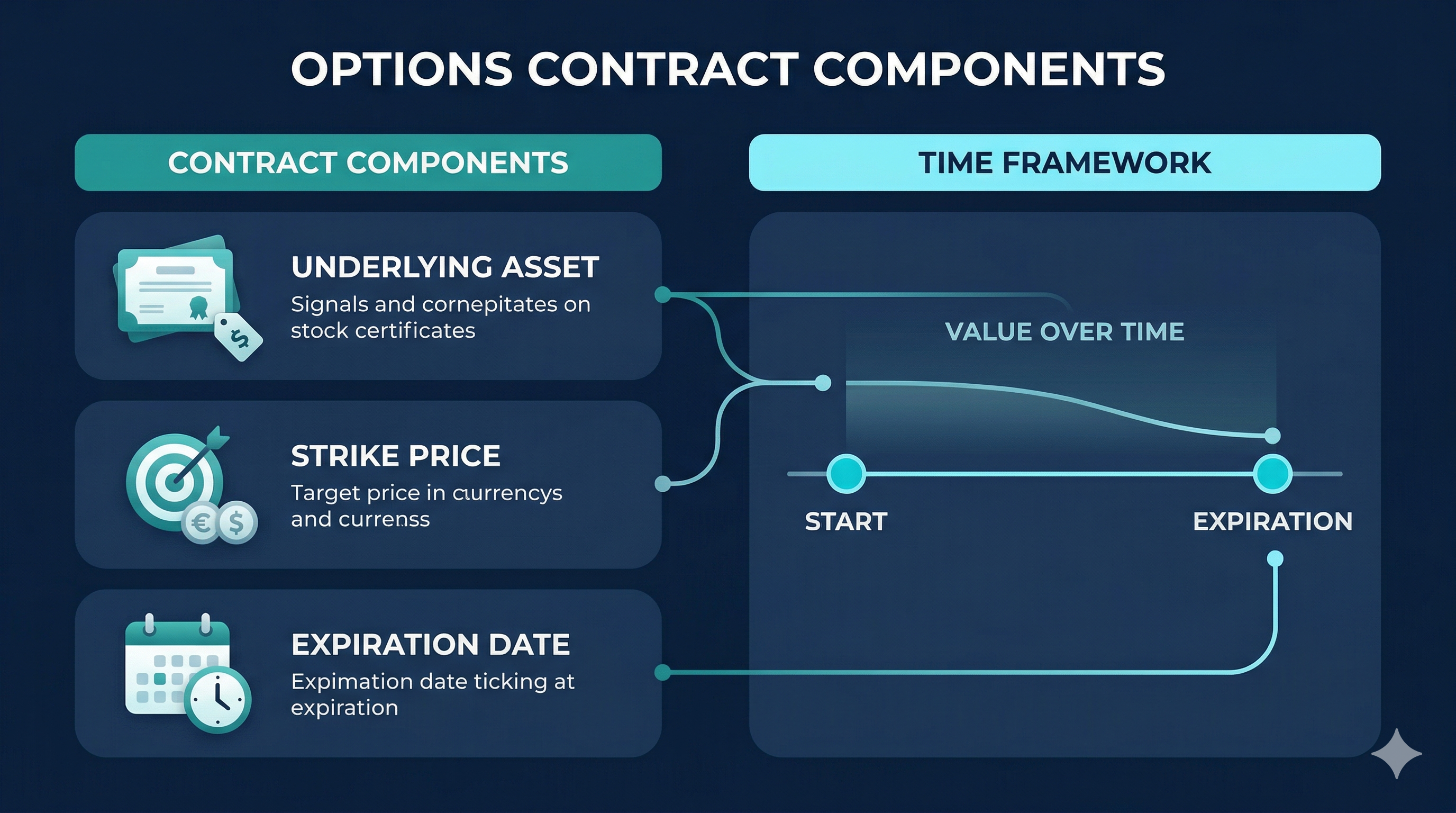
An options contract is a standardized financial agreement that defines rights related to an underlying asset.
It includes parameters such as:
- Strike price
- Expiration date
EXPLANATION
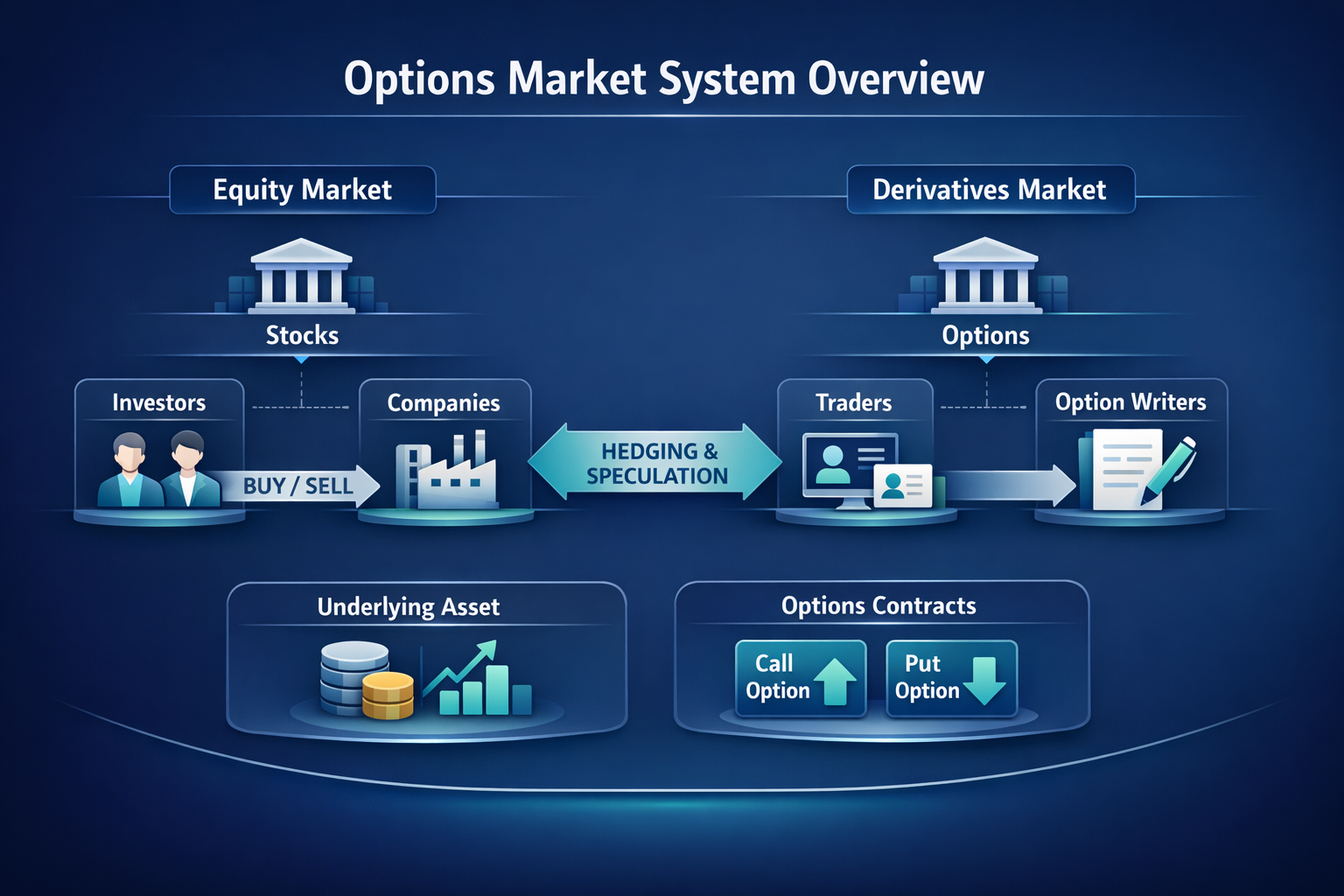
Financial markets include:
- Primary instruments (equities)
- Derivative instruments (options)
Equities represent ownership.
Options represent contractual relationships.
That difference changes everything.
In Indian markets, derivatives trading—especially index options—is highly active on exchanges like National Stock Exchange of India.
These contracts follow standardized rules:
- Lot size
- Expiry cycles
- Settlement mechanisms
Options pricing is influenced by multiple variables:
- Underlying price
- Time to expiry
- Volatility
Which leads to a key insight:
Options are not single-variable instruments.
They are multi-variable systems.
STRUCTURE OF OPTIONS CONTRACTS
Structural Characteristics
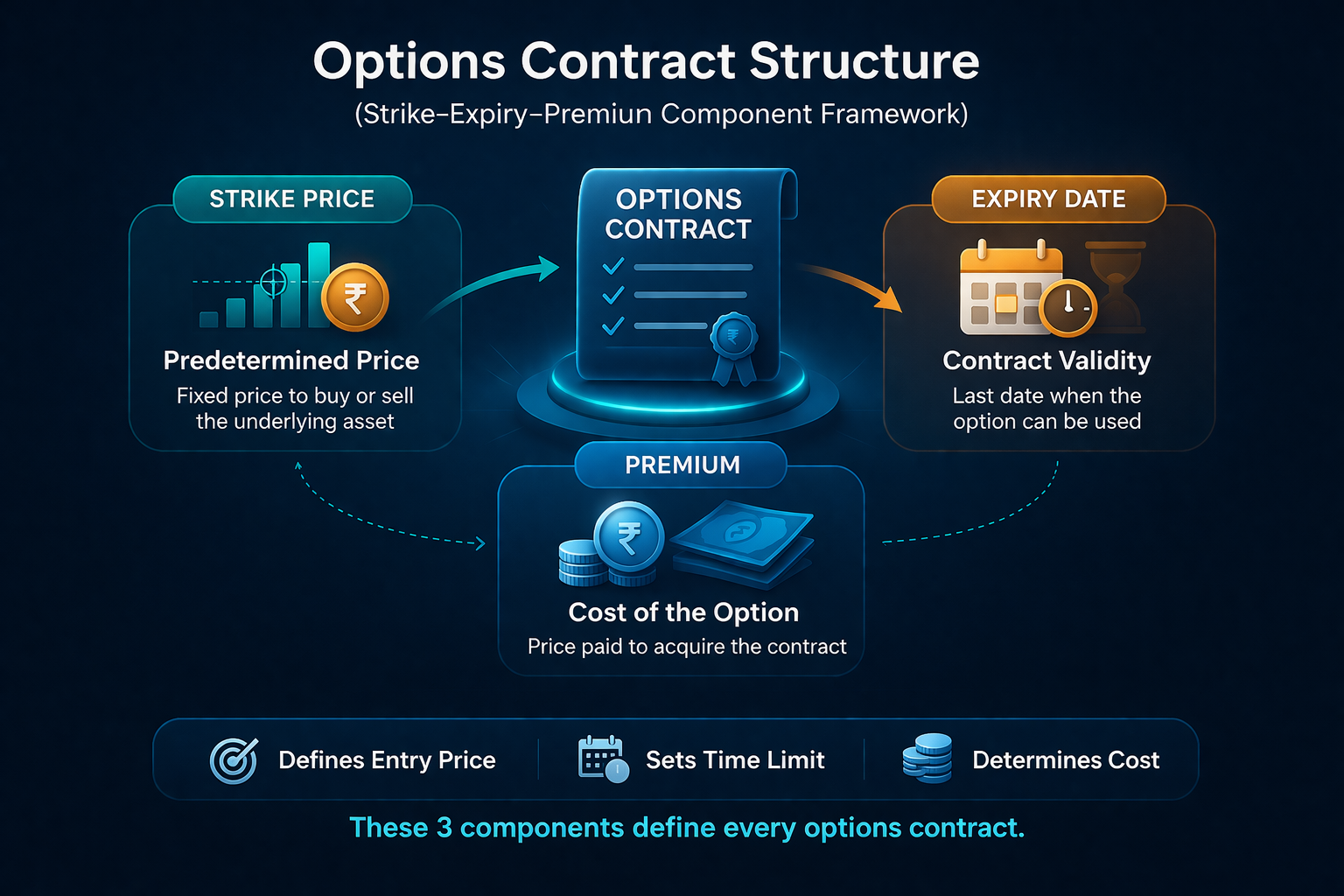
Options contracts include:
- Strike price
- Expiration date
- Premium
These define how the contract behaves.
Market Context (India)
Index options such as Nifty and Bank Nifty are widely traded in India.
Behavioural Consideration
Beginners often focus only on price movement.
But ignore contract structure.
And that leads to misinterpretation.
ROLE OF UNDERLYING ASSETS
Structural Characteristics
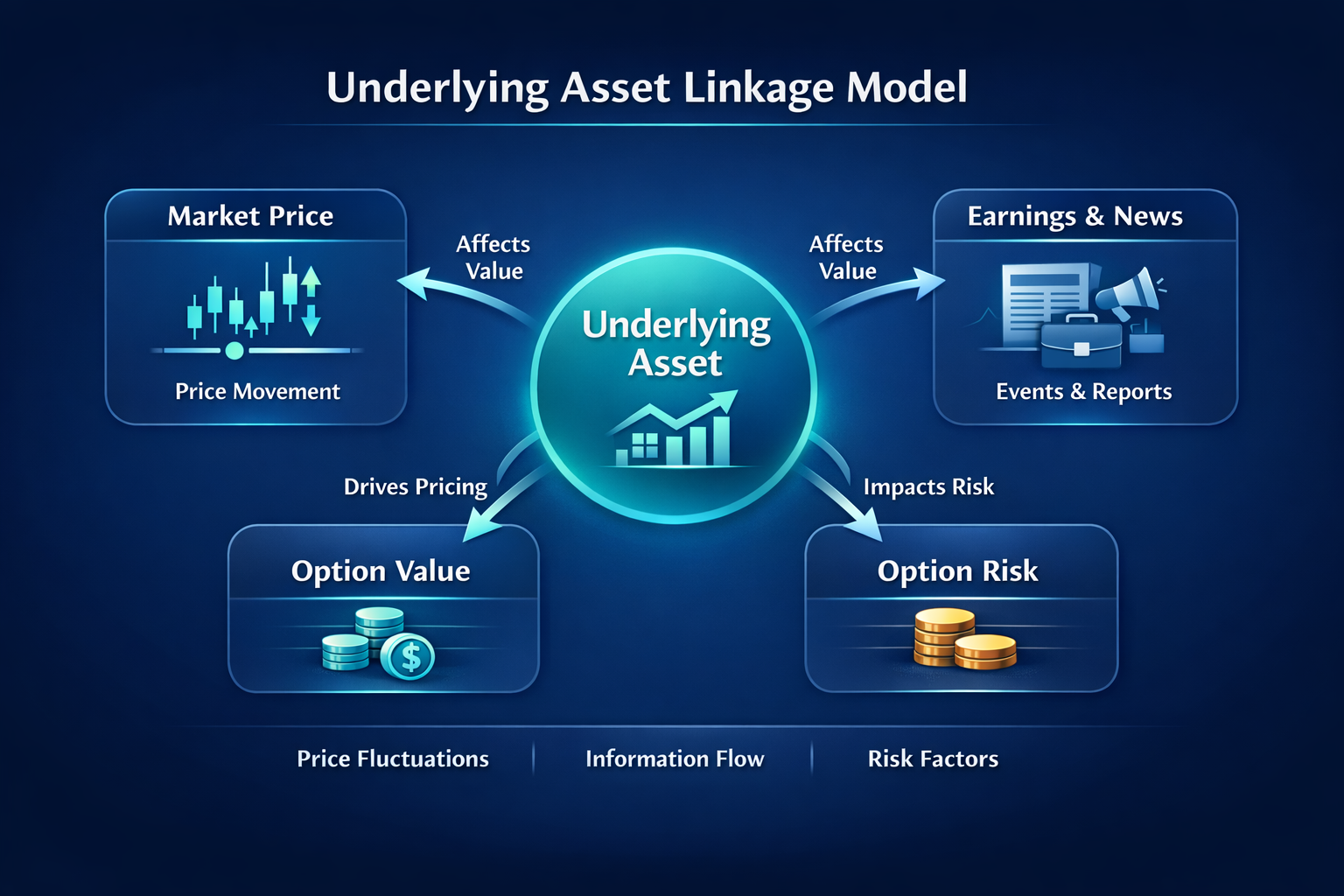
Options derive value from underlying assets such as stocks or indices.
Market Context (India)
Index options are commonly linked to indices like Nifty 50.
Behavioural Consideration
Many assume a direct one-to-one relationship.
But options do not move in a simple linear way.
INFLUENCE OF TIME AND VOLATILITY
Structural Characteristics
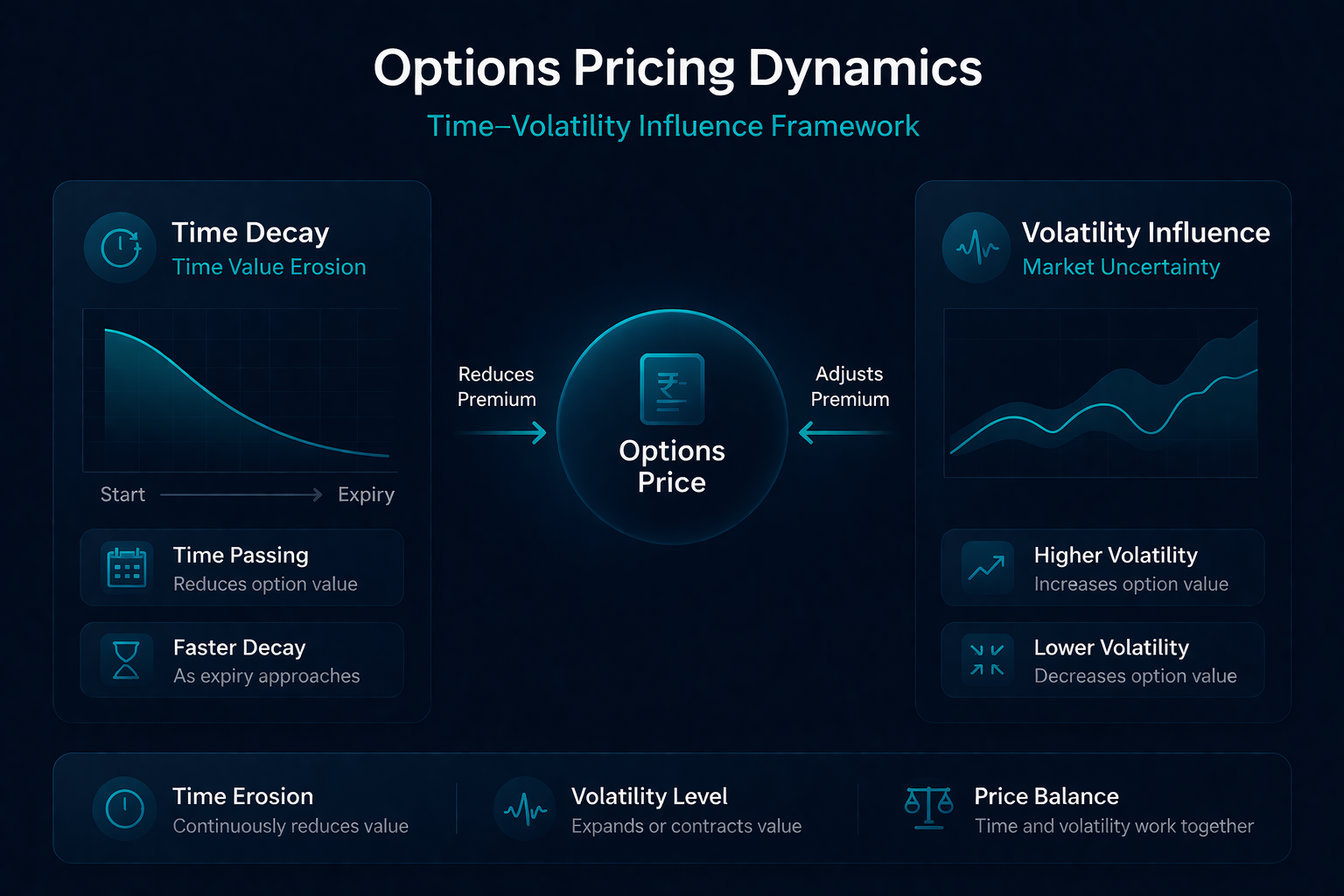
Options are time-bound instruments.
Their value changes with:
- Time decay
- Volatility shifts
Market Context (India)
Weekly and monthly expiry cycles impact how options evolve.
Behavioural Consideration
Beginners often underestimate these factors.
But time and volatility are not secondary.
They are core drivers.
COMPARISON TABLE
| Concept | Core Issue | Market Impact | Learning Challenge |
|---|---|---|---|
| Options Contracts | Multiple variables | Complex pricing | Understanding structure |
| Underlying Assets | Indirect linkage | Dependent movement | Interpreting relation |
| Time & Volatility | Additional factors | Dynamic behaviour | Multi-variable analysis |
KEY TAKEAWAYS
- Options involve derivative contracts
- Contract structure defines behaviour
- Underlying assets influence value
- Time and volatility add complexity
Understanding does not guarantee outcomes.
COMMON BEGINNER MISTAKES
- Treating options like equities
- Ignoring contract structure
- Misreading underlying relationship
- Overlooking time-based factors
- Underestimating volatility
These are not technical mistakes.
They are structural misunderstandings.
LIMITATIONS
Conceptual understanding provides clarity.
But does not capture real-time dynamics.
Options markets operate under:
- Multiple variables
- Changing conditions
- Uncertainty
RISK AWARENESS
Investor awareness material from Securities and Exchange Board of India highlights that derivatives involve higher complexity.
Insights from Reserve Bank of India indicate that broader economic conditions also influence derivatives markets.
Complexity is inherent.
It cannot be simplified away.
WHAT THIS DOES NOT DO
Understanding options basics:
- Does not ensure outcomes
- Does not remove uncertainty
- Does not simplify markets
BEGINNER LEARNING PATH
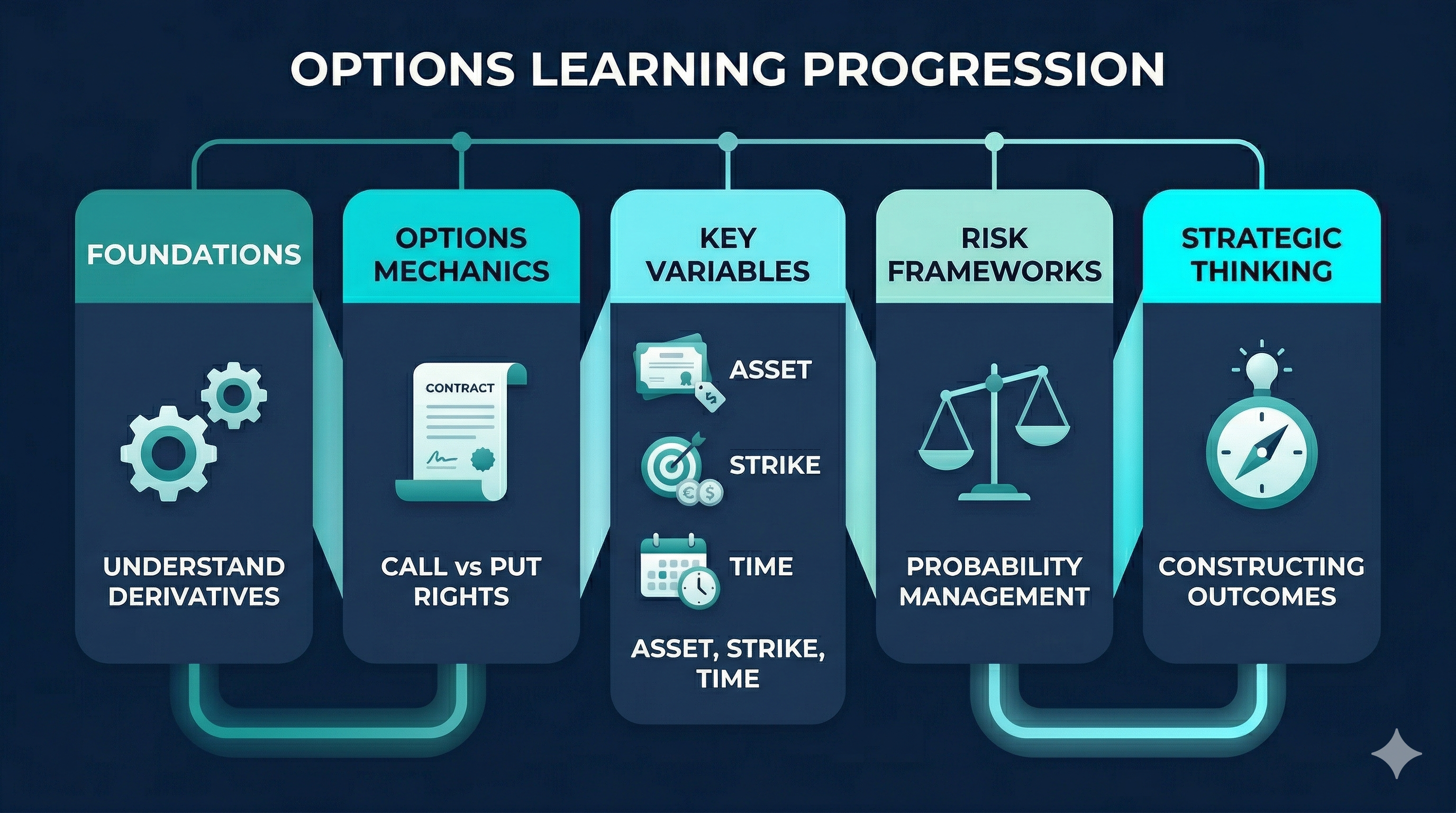
- Understand financial terminology
- Study equity market structure
- Learn derivatives concepts
- Explore options structure
- Develop awareness of risk and complexity
FAQ SECTION
What is options trading in India?
It involves derivative contracts based on underlying assets.
Why are options complex?
Because multiple variables influence their behaviour.
What is an underlying asset?
The asset from which the option derives value.
Are options widely traded in India?
Yes, especially index options on NSE.
Can beginners easily understand options?
They require structured and gradual learning.
FINAL PERSPECTIVE
Options trading is often approached as an opportunity.
In reality, it is a structured system.
It is not about quick understanding.
It is about layered learning.
Markets do not become easier with access.
They become clearer with structure.
AUTHOR
Vicky Mehta
Stock Market Trainer & Mentor
Founder & CEO – Succinct Learning Platforms Pvt. Ltd.
With over 20+ years in financial markets, his work focuses on structured trading education, behavioural frameworks, and risk management. He holds an MBA in Financial Markets in collaboration with NSE Academy and is an NSE Certified Market Professional.
SOURCES
- SEBI – Investor Awareness Material
- NSE – Market Data
- RBI – Financial Stability Reports
DISCLAIMER
This article is for educational purposes only and does not constitute financial advice.
Financial markets involve risk, including potential loss of capital. Readers should consult a SEBI-registered investment advisor before making financial decisions.
other related topics
Step-by-Step Guide to Start Trading in India (Beginner Checklist)
CONTINUE LEARNING
If you’re trying to understand markets in a more structured way,
I share short, focused breakdowns regularly here: